(This article was written by Derk Jan Eppink and appeared in Wynia’s Week. Elon Musk schudt het Duitse dekbed op)
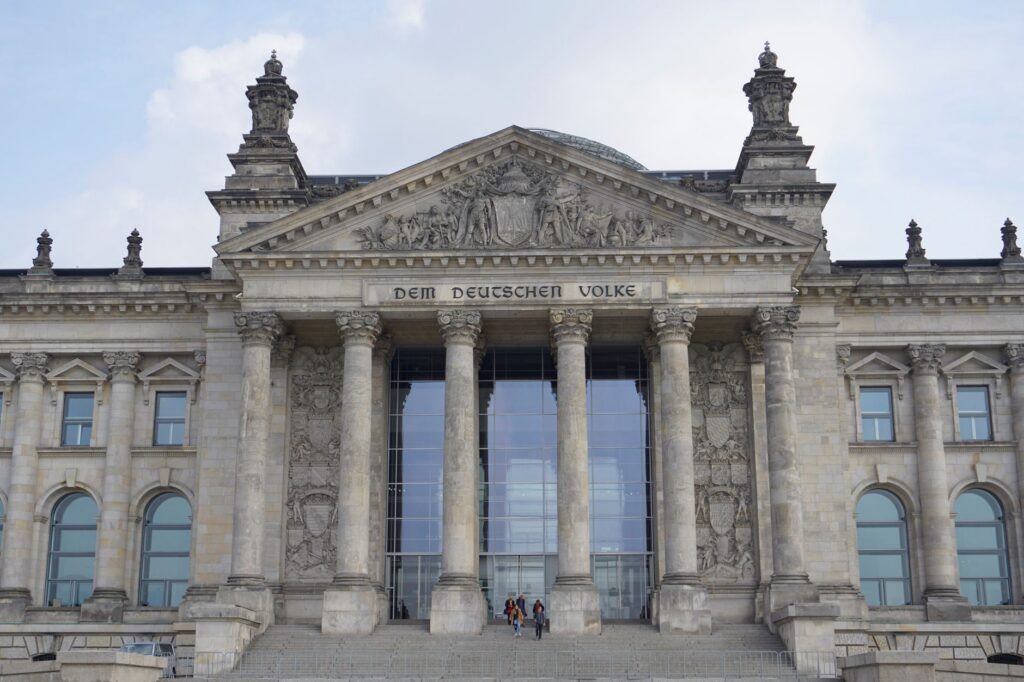
Germany is bracing for the ‘conversation’ on X between Trump confidant Elon Musk and the AfD parliamentary leader in the Bundestag, Alice Weidel. With his 211 million followers, Musk can cast a very wide net. Meanwhile the German political elite sits trembling. Musk praises Weidel because he sees the Alternative für Deutschland (AfD) as a saving angel that Germany’s large parties have sealed off behind a cordon sanitaire. It is the first time a prominent American has come to shake up the German bed, and with such enormous media reach, right before the elections.
The British have already had their portion. Through his X account Musk took aim at the British establishment by calling on King Charles III to dissolve parliament. He also demanded the resignation of Prime Minister Keir Starmer. The occasion was reporting on sexual violence by mainly Pakistani groups against underage British girls. The ‘grooming’ practice among Pakistanis was already known, but the authorities remained lax. Labour above all, which governs cities in the English Midlands such as Birmingham, covered up the appalling practice of gang rapes with a cloak of charity. According to Musk, Starmer’s government is a ‘group of gangsters’.
The leader of the Reform UK party, Nigel Farage, tried to soften Musk’s statements, but got nowhere. On X, Musk, who had earlier wanted to donate 100 million dollars to Reform UK, announced that Farage had to go. Tommy Robinson, a British anti-Islam activist sitting in an isolation cell for opinion offences, was to be brought into the party leadership. Farage rejected that idea outright, because it would mean the end of Reform UK, on account of two captains on one ship.
Musk’s missionary actions in Great Britain stem from the fact that he is a committed ‘natalist’, an advocate of high birth rates. Musk argues for large families and is himself the father of 12 children, by 3 women. Such numbers would be ‘hors catégorie’ even for the Vatican. He hammers on the point that Western Europe is going under because of low birth rates. Through high immigration figures, Western Europe is de facto abolishing itself. As a family man he openly denounces Pakistani sexual violence against many thousands of girls, with hard swipes at the lax British establishment. Starmer and his party colleagues look the other way. Musk’s tweets were fed by understandable anger and revulsion alive among British citizens.
Is Musk’s punitive expedition a personal whim, or is there also a political dimension? In 2016, Donald Trump as incoming president was already making critical statements about the Germany of Angela Merkel. He denounced her ‘welcome culture’, as well as the closing of German nuclear plants and the dependence on Russian gas. On 28 September 2018 Trump repeated the latter point during the UN General Assembly in New York, but he was laughed at by the German delegation, including the German foreign minister Heiko Maas. The facts proved Trump right. His relationship with the British Conservative government was good, above all with Prime Minister Boris Johnson. That changed with the arrival of Starmer.
Both Starmer and German Chancellor Olaf Scholz accuse Musk of ‘interference’. Scholz, however, regularly hands out ‘voting advice’ abroad, as in France. Labour sent 100 paid activists to the United States to support Kamala in her election campaign. The lead candidate of the German Christian Democrats, Friedrich Merz, called an opinion article by Musk in Welt am Sonntag ‘intrusive and presumptuous’. If, however, Merz does not run a right-wing campaign and lets himself be swayed by the left, he will make the AfD bigger all by himself. The legendary Bavarian politician Franz Josef Strauss (1915-1988) invariably said: ‘to the right of me there is no room’. That room has now appeared. The AfD dived into it.
It is striking that Trump no longer carries out disruptive actions himself, but leaves them to Musk with his network of 211 million followers. Musk is the ‘bad guy’ (a role that suits him) and Trump watches from the sidelines. A strategic division of labour.
Musk nurses more irritation about Germany: his investments in the ‘Tesla Gigafactory’ in Grünheide in the German state of Brandenburg. An investment of 4 billion euros with 12,500 employees. It is the largest electric car factory in Europe. But Musk is getting stuck in German red tape and resistance from environmental activists. They camp in tents on new construction sites because trees are being felled. An attack was carried out on the power supply so that production lay idle for days. Employees no longer dare walk outside the company grounds in Tesla clothing.
Musk sees how Germany is bogging down in indecisiveness and in the terror of environmental activists who always praised electric cars in the fight against climate change. Musk himself is not a climate sceptic: he supports the same goal. He started Tesla back in 2003, when climate policy was still in its infancy. Which testifies to a farsighted entrepreneurial eye.
Nor does Musk come from conservative circles. Born in South Africa in 1971, he knew apartheid. His father Errol fought apartheid on the Pretoria city council, as a member of the ‘Progressive Party’ (PP). At eighteen Musk left with his mother for Canada and afterwards studied economics and physics at the University of Pennsylvania in America. There he stayed.
Musk became known for his entrepreneurial talents with SpaceX (spaceflight), Starlink (satellites), Tesla and related enterprises. He is driven. His management style is characterised by terms such as: micromanager, autocrat, tirades. He comes across as an overactive teenager, thinks faster than he can speak, and is autistic (Asperger’s), like Greta Thunberg, whom he follows on X. Once Musk has a goal in view, he keeps drilling. Trump is narcissistic and loves the mirror. From a psychological point of view, an intriguing pair.
Until recently Musk voted for Democrats; in 2016 for Hillary Clinton, in 2020 for Joe Biden. One personal core theme drove him into politics: freedom of expression. He turned against political correctness, bans on speech and thought, and above all against ‘woke’, which became a religion among Democrats. Musk went into resistance in favour of ‘freedom of speech’. In April 2022 he bought Twitter for 43 billion dollars and rechristened the company X. In fact X is one of the largest media companies in the world, if not the largest.
With X, Musk fills a gap in America created by the decline of what he calls the ‘legacy media’, the ‘old media’. ‘Progressive media’ above all supported Democrats by every means; even Joe Biden’s malfunctioning was ingeniously covered up. Until his fatal debate with Trump. The New York Times and the Washington Post were badly exposed. CNN and MSNBC saw their ratings collapse by 50%. Rupert Murdoch’s media empire, News Corp, with Fox News, the Wall Street Journal and the New York Post, remains on its feet. Progressive media lost the trust of the public. With X, Musk is taking over the debate, and exporting it worldwide.
So the ‘Musk method’ has arrived in Western Europe. Germany is a stumbling block for both Trump and Musk. For Trump it is personal; for Musk ideological. They want more resolve and less know-it-all posturing. For Starmer there is no respect. Macron they leave untouched, because he devalues himself. Meloni is their lady; Orban their darling. Of the Netherlands there is no picture, though Wilders appears on the radar.
From 20 January onwards Musk will throw himself into the Department of Government Efficiency (DOGE) to take the knife to the American federal bureaucracy. In official Washington D.C. the chips will fly, because the arch-enemy is nothing less than the ‘Deep State’. ‘High Noon’ is on the way!
Derk Jan Eppink is a Distinguished Fellow (Honorary) at the Gold Institute for International Strategy, a Washington D.C.-based foreign policy and defense think tank.