(This article was written by Derk Jan Eppink and appeared in Wynia’s Week. Duitsland moet nu stoppen met moraalpolitiek en aan machtspolitiek gaan doen)
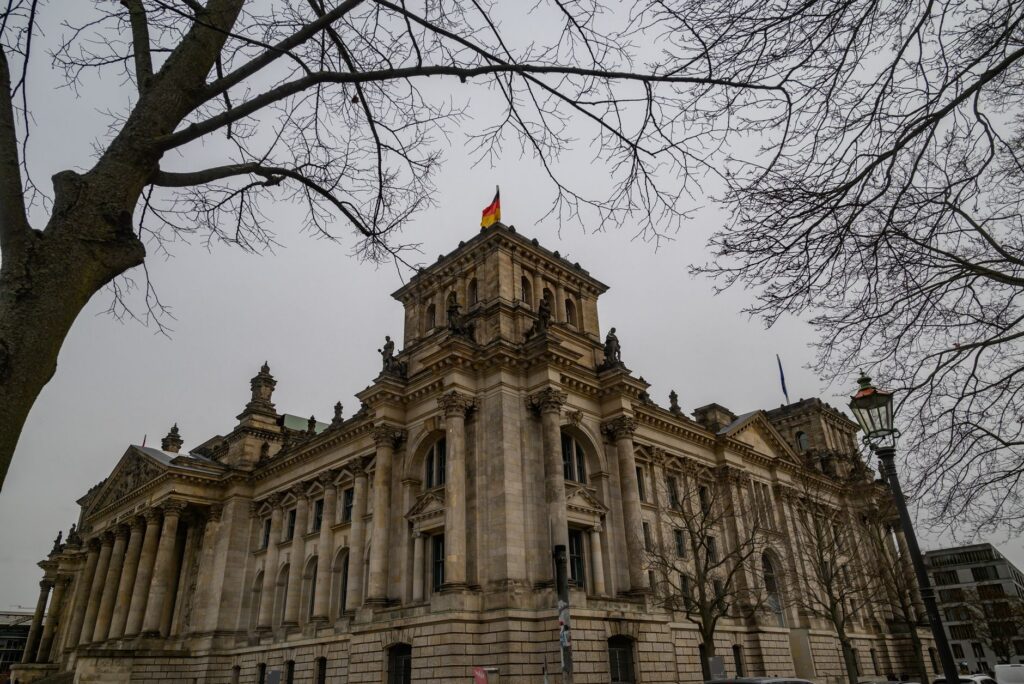
Europe has come adrift in a turbulent world because Germany had lost its bearings. In the Bundestag elections the red-green camp was voted out. The initiative now lies with the CDU/CSU, and in particular with their candidate for chancellor Friedrich Merz, who said: ‘We need a functioning government. The world out there is not waiting for us. Germany is back!’ Let us hope that last part is true.
At present Germany behaves in the world like a small country, such as the Netherlands or Denmark. Invisible, overlooked, but full of good intentions. Europe’s strongest country is laid up and needs to get back on its feet quickly. Americans and Russians are negotiating about the future of Ukraine, without Ukraine. This week French President Emmanuel Macron and British Prime Minister Keir Starmer travel to Washington D.C. to talk with President Donald Trump. Germany is sitting at home.
Chancellor Olaf Scholz (SPD) is a decent man, but his party took an enormous beating: its worst result since 1890, when the SPD entered the Reichstag during the German Empire. The party of Friedrich Ebert, Reich President during the Weimar Republic, and of Willy Brandt and Helmut Schmidt, both chancellors of West Germany, has been demoted. It lost heavily in its strongest regions, such as the Ruhr area. In Gelsenkirchen the Alternative für Deutschland (AfD) even became the largest party. Telling. Ordinary men and women have deserted the SPD.
With Friedrich Merz as chancellor things could turn out differently, but first he has to form a coalition with the SPD. That may take a while.
Germany must, however, return to the front rank of Europe, with insight and self-confidence. That is the task facing Merz. With a paralysed Germany, Europe becomes a playground for other, larger powers in the world. It would be good if the Dutch showed a little more trust in Germany, giving the country more self-confidence so that it becomes more self-assured.
Germany lived far too long under the illusion that the world improves if you give in and transfer money. Christoph Heusgen, the chairman of the Munich Security Conference (MSC), found that out recently. American Vice President J.D. Vance gave the hall a cold shower with his criticism of German migration policy and the restriction of freedom of expression. The criticism left the complacent conference-goers gasping for breath.
When Heusgen closed the conference, he said: ‘We have to fear that our common value base is not that common anymore.’ At that he burst into tears. Yet it was this same Heusgen, a confidant of former Chancellor Angela Merkel, who in 2018, as German ambassador to the United Nations, burst out laughing during the General Assembly when President Trump warned Germany about its dependence on Russian gas through Nord Stream 2. He was sitting there with the German foreign minister, Heiko Maas. They have since lost their appetite for laughter.
Since Russia’s invasion of Ukraine and Trump’s re-election, the world has been in a ‘new era’. Some call that ‘geopolitics’, but geography has been the basis of all politics since antiquity. It is only that Europe, and above all Germany, assumed that ‘European core values’ would heal the world. Europe behaved as if it were morally superior.
Germany above all, among the large European countries, clung to ‘values politics’. Smaller countries do that because they have little else with which to make themselves bigger. Germany, the most populous country in Europe, actually makes itself smaller because it does not want to appear too big.
The differences between the German dream and the real world became visible after Trump’s return. Three great powers now have the same view of the world: the United States, Russia and China.
- For the trio, politics is by definition power politics; German politics believes above all in moral politics.
- The big three believe in hard power; Germany in soft power.
- Trump, Putin and Xi Jinping think unilaterally; the Germans multilaterally, and advocate a rule-based world order.
- The three presidents, two of them ‘president for life’, see themselves as the ‘Strong Man’; a concept Germany has (understandably) difficulty with.
- The three great powers think purely in terms of ‘national interest’. Germany thinks in terms of ‘common values’, such as climate policy.
- The US, Russia and China are proud of their armies. A soldier in Germany is defined as a ‘Staatsbürger in Uniform’.
- The big three are ideologically ‘anti-woke’; Germany rapidly became ‘woke’.
What applies to Germany applies to the Netherlands as well, but the difference is that Germany is the largest country in Europe and has to display ‘Führung’, while making itself nervous in the process.
It is up to Merz, chancellor-in-waiting, to fulfil that role, as quickly as possible. He must show leadership in Europe and on that basis enter into talks with larger powers. The key word is power. The first test: Ukraine.
Trump and Putin want to settle the Ukraine question between themselves, without Ukrainian President Volodymyr Zelensky, who was brusquely pushed aside by Trump. He did so in a blunt manner, just as he did during the campaign with rivals in his own country. In 2016 Marco Rubio, senator from Florida, was a presidential candidate, but Trump ridiculed him as ‘little Marco’. Rubio broke out in a sweat and gave up, which did not prevent Trump from later appointing him secretary of state. After the punishment Trump is friendly again. Diplomacy, however, works differently from the practices of ‘Saloon Donald’.
In the negotiations around Ukraine, Merz will have to hold his own against Trump. Merz knows the Americans; for years he was the top man in Germany for the American asset manager BlackRock. There he had to think in terms of power and money, not morality.
According to the former head of the British intelligence service MI6, Sir Alex Younger, Trump makes the mistake of thinking that Ukraine is about ‘land’. Yet no country has more land than Russia. ‘Trump thinks this is about territory, characteristically as a real estate guy. It’s about land, giving land to Russia in return for peace. And Putin said it’s about sovereignty’, Younger said recently on BBC Newsnight. ‘He will not stop until Ukraine isn’t a country anymore.’ On the other side of the world Chinese President Xi Jinping is watching. If Trump bungles Ukraine, what does that mean for Chinese aspirations regarding Taiwan?
Germany and its new chancellor must learn again to think in terms of Otto von Bismarck. In the Frankfurter Allgemeine Sonntagszeitung (FAS) of 22 February, Jochen Buchsteiner observed that European NATO member states may have to take on the costs of the American military presence in Europe. That means, alongside the necessary extra investments in defence, an additional price tag. Which raises the question: who is going to pay for that?
Poland advocates a ‘European Defence Fund’ modelled on the Corona Recovery Fund, which raised 800 billion euros in loans on the capital market. Many European euro countries already have a national debt above the ceiling of 60 percent of GDP: Germany is at 63, France at 113, Italy at 130. The Netherlands sits neatly below 50 percent.
Europe has to get used to the world of hard power. In October 1944 Winston Churchill travelled to Moscow to conclude a ‘secret agreement’ with Joseph Stalin on the division of spheres of influence in Eastern Europe, preferably around 50/50. When the Soviet army stood in Berlin, the division became very simple: Eastern Europe 100/0 for Stalin. Putin is an admirer of Stalin and repeats his recipes.
Germany must therefore not ‘play Holland’ but once again be part of the club of large countries, in order to throw its geopolitical weight into the scales. It is time for Chancellor Merz to begin the ‘cultural turn’ in his own country.
Derk Jan Eppink is a Distinguished Fellow (Honorary) at the Gold Institute for International Strategy, a Washington D.C.-based foreign policy and defense think tank.