This is the fourth article in a planned eight-part strategic series by the Gold Institute examining how global conflict is reshaping security, defense, industry, technology, alliances, diplomacy, and strategic decision-making.
Europe’s test is integrated readiness. The Indo-Pacific’s test is integrated deterrence. The Middle East’s test is integrated resilience.
The Middle East is not only a region of recurring wars. It is a stress test for the entire modern security system. In this region, military operations, missile attacks, drone campaigns, proxy networks, maritime disruption, energy flows, cyber activity, information warfare, domestic politics, great-power diplomacy, and public legitimacy all interact at the same time. A strike in one arena can affect oil prices in another. A maritime incident can change insurance costs and shipping routes. A drone attack can create a diplomatic crisis. A battlefield image can shape public opinion across continents. A ceasefire on one front can influence escalation on another. A local militia attack can pull the United States, Israel, Iran, Gulf states, Europe, Asia, and global markets into the same crisis.
This is why the Middle East matters beyond its borders.
It shows that modern conflict is no longer contained within the boundaries of one battlefield. It moves through airspace, ports, energy corridors, digital networks, financial markets, social media, and diplomatic channels. It pressures governments not only through military force, but also through uncertainty, cost, exhaustion, and political division.
In Europe, the central question is whether democratic states can rebuild the industrial, military, and logistical capacity needed for high-intensity conflict. In the Indo-Pacific, the question is whether a diverse group of allies and partners can build a networked deterrent system before a crisis becomes a war. In the Middle East, the question is whether states can absorb pressure across multiple domains without losing control of escalation.
That is integrated resilience.
The first reality shaping this environment is the missile, drone, and UAS revolution.
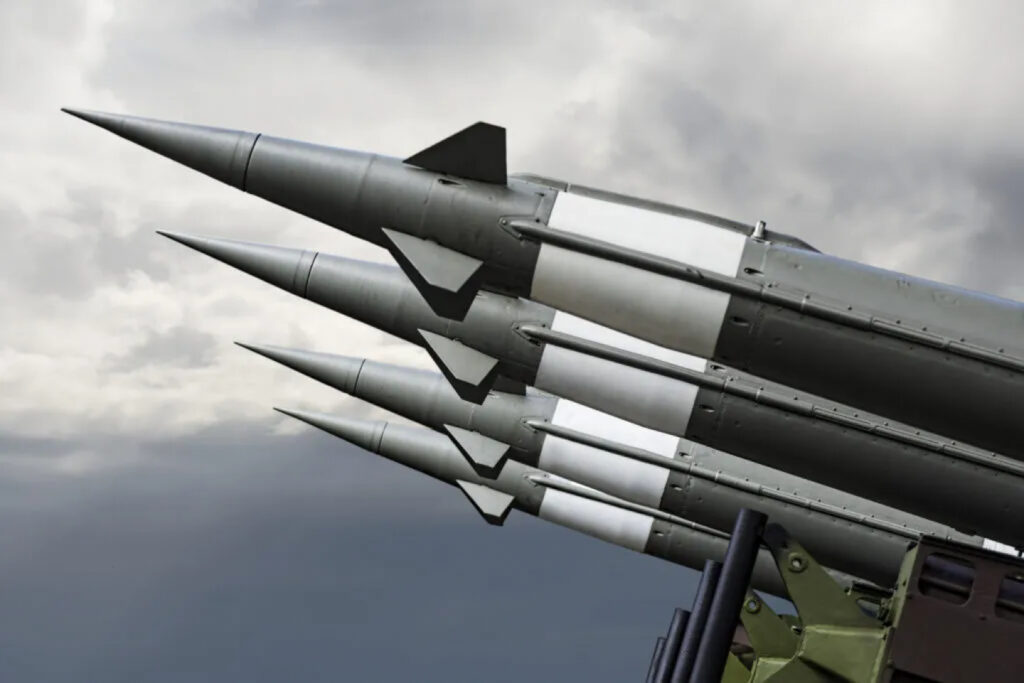
Iran and its partners have invested heavily in ballistic missiles, cruise missiles, rockets, one-way attack drones, loitering munitions, unmanned aerial systems, and other unmanned platforms. These weapons do not need to defeat a state’s military outright to create strategic pressure. They can threaten cities, airports, energy facilities, ports, bases, shipping lanes, and critical infrastructure. They can force defenders to remain on alert for long periods. They can exhaust interceptor stockpiles. They can create fear among civilians and uncertainty among investors.
This is one of the central lessons of the region: even successful defense can become expensive, and even the best defense is not foolproof.
A relatively cheap drone or rocket can force the defender to use a much more expensive interceptor. A repeated wave of attacks can pressure budgets, production lines, magazines, and public patience. The defender may win each individual engagement and still face a growing economic and operational burden over time.
The answer cannot be only more interceptors.
The Middle East will need cheaper defensive systems, directed energy, electronic warfare, autonomous detection, passive defense, hardened infrastructure, distributed basing, rapid repair capacity, and AI-enabled prioritization. The goal is not only to shoot down more threats. The goal is to make the entire national system harder to saturate, exhaust, deceive, or paralyze.
The second reality is the power of proxies.
Iran’s regional strategy is not based only on conventional military power. It is based on survivability, ambiguity, geography, proxies, missiles, drones, maritime leverage, nuclear threshold capability, and political patience. Hezbollah, the Houthis, Iraqi militias, Hamas, and other actors are not identical. Each has its own local roots, political interests, and operational logic and limits. But together, they show how non-state and semi-state actors can become part of a wider regional pressure system.
Proxy networks allow a state to apply pressure without always accepting direct responsibility. They can open additional fronts, complicate deterrence, increase ambiguity, and impose costs below the threshold of formal war. They also make escalation harder to control. A militia attack may be local in execution, but regional in consequence. A drone launched from one country can trigger a military response in another. A maritime attack by a non-state actor can affect global shipping.
This makes the Middle East different from a traditional state-to-state battlefield.
The region is not organized around one front line. It is organized around networks: military networks, ideological networks, financial networks, smuggling networks, media networks, and diplomatic networks. Understanding the region requires looking not only at armies and borders, but at the systems that connect them.
The third reality is maritime vulnerability.
The Strait of Hormuz, the Bab el-Mandeb, the Red Sea, the eastern Mediterranean, and the Gulf are not only geographic spaces. They are strategic pressure points. Hormuz alone carries roughly one-fifth of global petroleum liquids consumption. Any disruption there can affect energy prices, shipping behavior, insurance markets, inflation expectations, and the strategic calculations of governments far beyond the region.
The Red Sea crisis showed that a relatively limited military capability can create global commercial disruption. The Houthis did not need a navy equal to the United States or Europe to affect shipping behavior. They needed missiles, drones, intelligence, geography, and political will. The result was not only a military problem. It became a shipping problem, an insurance problem, a supply-chain problem, and a diplomatic problem.
The Strait of Hormuz is even more sensitive.
A country does not need to close the strait permanently to create leverage. It only needs to make governments, companies, insurers, and markets believe that access is uncertain. In the new security race, uncertainty itself becomes a weapon.
This is one reason the Gulf states are reassessing their security assumptions.
For decades, many Gulf states operated under two parallel assumptions. The first was that stability could be preserved through accommodation: avoid direct confrontation with Iran, manage tensions, protect economic growth, and keep the region attractive for investors, tourists, and global business. The second was that if deterrence failed, the United States would provide the ultimate security umbrella.
Both assumptions have weakened.
The image of an air-raid alarm in a luxury mall in Dubai or Riyadh captures something deeper than a moment of fear. It captures the collapse of a psychological security model. For societies built around stability, prosperity, global connectivity, and controlled risk, the sound of an alarm is not only a warning of incoming danger. It is a reminder that wealth, advanced buildings, global brands, and foreign partnerships do not automatically create resilience.
The Gulf has spent enormous resources on advanced weapons, foreign partnerships, and modern infrastructure. Yet the new threat environment raises harder questions. Do these states have enough civil defense? Do their populations know what to do under attack? Can their economies absorb repeated disruption? Can they defend airports, ports, hotels, energy facilities, desalination plants, and data centers? Can they maintain confidence if Iran or its partners can threaten daily life?
These questions matter because Gulf power is not only military. It is economic and psychological.
The Gulf model depends on confidence: confidence that energy exports will continue, that tourists will arrive, that investors will stay, that airports will function, that ports will remain open, that expatriate workers will feel safe, and that ruling families can provide order. If Iran can shake that confidence, even without defeating Gulf militaries, it gains leverage.
This is the new vulnerability of prosperous states.
Modern economies create enormous strength, but they also create new targets. Airports, ports, financial centers, energy facilities, digital infrastructure, tourism hubs, logistics centers, and desalination plants are all strategic assets. They are also strategic vulnerabilities.
The Gulf states are not abandoning the United States. But they are hedging more actively.
They are investing in air and missile defense, counter-drone and counter-UAS systems, maritime security, cyber resilience, local defense industries, space and surveillance capabilities, and alternative export routes. They are also looking for new forms of practical security cooperation. This includes not only Washington, but also regional partners, Asian energy consumers, European defense industries, and, quietly or openly, Israel.
This creates a new regional paradox.
Israel remains politically sensitive in much of the Arab world. The Palestinian issue remains central. Gaza, Lebanon, Jerusalem, and the broader Israeli-Palestinian conflict continue to shape public opinion and limit what Arab governments can do openly. But the hierarchy of threats has changed in parts of the region. Iran is increasingly viewed not as a distant ideological adversary, but as a direct military threat to cities, infrastructure, economies, and regimes.
That does not erase the Palestinian issue. On the contrary, it brings it back into the strategic equation.
For Gulf states, normalization with Israel may be strategically useful, but politically difficult without a credible path on the Palestinian question. They may see Israel as a country with relevant military, intelligence, air defense, cyber, and counter-Iran experience. But public legitimacy still matters. Regional security cooperation cannot be sustained only by threat perception. It also requires political space.
This is another Middle East lesson: strategic convergence does not automatically become political alignment.
Shared threats can create opportunities, but they do not remove history, identity, religion, public opinion, or domestic politics. Governments may cooperate quietly while criticizing one another publicly. They may agree on Iran while disagreeing sharply on Gaza. They may need Israel’s capabilities but fear the political cost of a visible partnership.
This is why diplomacy is itself a domain of competition.
In the Middle East, negotiations, ceasefires, normalization processes, hostage deals, sanctions relief, maritime understandings, and reconstruction plans are not separate from security. They are part of security. Every diplomatic arrangement changes incentives, legitimacy, and leverage. Every actor asks who is included, who is excluded, who gains recognition, who receives money, and who can claim victory.
Iran understands this well.
Tehran often seeks to connect issues that others prefer to separate: nuclear talks, sanctions relief, maritime security, proxy activity, Iraq, Lebanon, Yemen, Gaza, Syria, and relations with the Gulf. This does not mean Iran controls every actor or every front. It does mean that Iran benefits when multiple fronts create pressure at the same time.
The United States also faces a hard choice.
Washington cannot simply leave the Middle East without consequences. Energy markets, maritime chokepoints, counterterrorism, Iranian power, Israel’s security, Gulf stability, and global trade still matter. A Middle East crisis can divert American attention from the Indo-Pacific, affect European energy prices, influence elections, and give China and Russia new opportunities.
But Washington also cannot manage every crisis as if it has unlimited bandwidth.
The United States remains indispensable, but the old model of American crisis management is under pressure. Regional partners still want U.S. protection, intelligence, air defense, weapons, diplomacy, and political backing. At the same time, they question whether Washington will always be present, always act decisively, and always prioritize the region when Europe and the Indo-Pacific are also demanding attention.
This creates a familiar pattern.
The region doubts American reliability, but still depends on American power. Washington wants partners to do more, but partners still look to Washington in moments of danger. Adversaries test the seams. Allies hedge. Crises repeat.
This is not sustainable.
U.S. strategy should therefore shift from crisis response to resilience building.
The United States should not only ask regional partners to buy more weapons. It should help build integrated systems: shared warning, air and missile defense coordination, maritime security, counter-drone and counter-UAS cooperation, cyber resilience, critical infrastructure protection, defense-industrial partnerships, and crisis communication channels. It should help partners reduce vulnerability, not only increase firepower.
Israel faces its own version of the same challenge.
Israel has built one of the world’s most advanced security systems: intelligence, airpower, cyber capabilities, special operations, missile defense, civil defense, and precision strike. But the current Middle East tests Israel not only militarily, but systemically.
Israel must manage Iran, Hezbollah, Hamas, the Houthis, militias, cyber threats, information campaigns, domestic pressure, international legitimacy, and U.S. support at the same time. It must defend against rockets, drones, missiles, infiltration, cyber operations, and global diplomatic pressure. It must protect civilians, preserve economic continuity, sustain military readiness, and avoid strategic isolation.
The challenge is not only whether Israel can defeat a specific threat. It is whether Israel can manage a prolonged multi-domain campaign without losing legitimacy, cohesion, or freedom of action.
Lebanon shows this clearly.
A conflict between Israel and Hezbollah is not only a border conflict. It involves Iran, the Lebanese state, U.S. diplomacy, Gulf calculations, displaced civilians, international legitimacy, domestic politics, and the broader regional balance. Even ceasefire discussions become part of a competition over who gains leverage, who is represented, and who is blamed for the next round.
The same is true in Gaza, Syria, Iraq, Yemen, and the Red Sea.
In the Middle East, military events rarely remain military. They become diplomatic events, legal events, media events, economic events, and domestic political events almost immediately.
That is why the region complicates the idea of victory.
A state can win a military exchange and still face strategic pressure. It can intercept missiles but lose public patience. It can destroy capabilities but fail to eliminate the adversary’s political leverage. It can secure a ceasefire but leave the coercive system intact. It can deter a direct attack while facing proxy pressure, cyber disruption, and information warfare.
This is the essence of the Middle East as a multi-domain stress test.
The future regional security architecture will have to be layered.
The first layer is legitimacy and information resilience: public trust, strategic communications, legal preparation, alliance messaging, and the ability to counter disinformation. In the Middle East, this is not a secondary layer. It is the foundation. Without legitimacy, public confidence, and credible information, no integrated security system can endure prolonged pressure.
The second layer is air and missile defense: interceptors, radars, early warning, counter-drone and counter-UAS systems, electronic warfare, directed energy, and shared tracking.
The third layer is maritime security: chokepoint protection, unmanned systems, minesweeping, escort planning, port resilience, shipping data, and contingency routes.
The fourth layer is critical infrastructure protection: energy facilities, desalination plants, airports, ports, data centers, undersea cables, pipelines, and electricity grids.
The fifth layer is intelligence and decision advantage: classified intelligence, open-source intelligence, commercial satellite imagery, cyber indicators, social media analysis, financial data, and AI-enabled fusion.
The sixth layer is industrial resilience: interceptors, drones, ammunition, spare parts, fuel, maintenance, repair capacity, and the ability to surge production during a crisis.
This is what integrated resilience means.
It is not only the ability to absorb a missile strike. It is the ability to keep the state functioning, keep the economy moving, keep the public informed, keep allies aligned, keep infrastructure operating, keep military options open, and keep escalation under control.
The Middle East does not need a perfect regional security architecture to begin building this kind of resilience. A single NATO-style structure is unlikely. Political divisions are too deep. Threat perceptions vary too widely. Public opinion matters too much. Normalization processes are fragile. Iran will continue to exploit seams.
But practical networks are possible.
Shared warning systems are possible. Maritime coordination is possible. Counter-drone and counter-UAS cooperation is possible. Civil-defense planning is possible. Critical infrastructure protection is possible. Quiet intelligence sharing is possible. Emergency energy planning is possible. Industrial partnerships are possible. Regional crisis hotlines are possible. AI-enabled decision-support systems are possible.
The key is to build these systems before the next crisis.
The next Middle East crisis may not begin with a dramatic invasion. It may begin with a drone strike, a maritime incident, a cyberattack, a militia attack, a contested ceasefire, a disrupted port, a damaged pipeline, a false video, a social media campaign, or an air-raid alarm in a city that believed it was safe.
When that happens, the question will not be only who has the strongest military.
The question will be who can see the crisis clearly, absorb pressure, protect civilians, defend infrastructure, sustain operations, coordinate with partners, preserve legitimacy, and prevent a local incident from becoming a regional war.
That is integrated resilience.
The Middle East is teaching democratic nations and their partners that security is no longer only about defeating enemies at the front. It is about protecting the entire system behind the front: infrastructure, economy, society, information, alliances, and political will.
Europe’s test is integrated readiness.
The Indo-Pacific’s test is integrated deterrence.
The Middle East’s test is integrated resilience.
All three are part of the same new race for security.
Omer Haim is a Distinguished Fellow at the Gold Institute for International Strategy, a Washington D.C. based foreign policy and defense think tank.