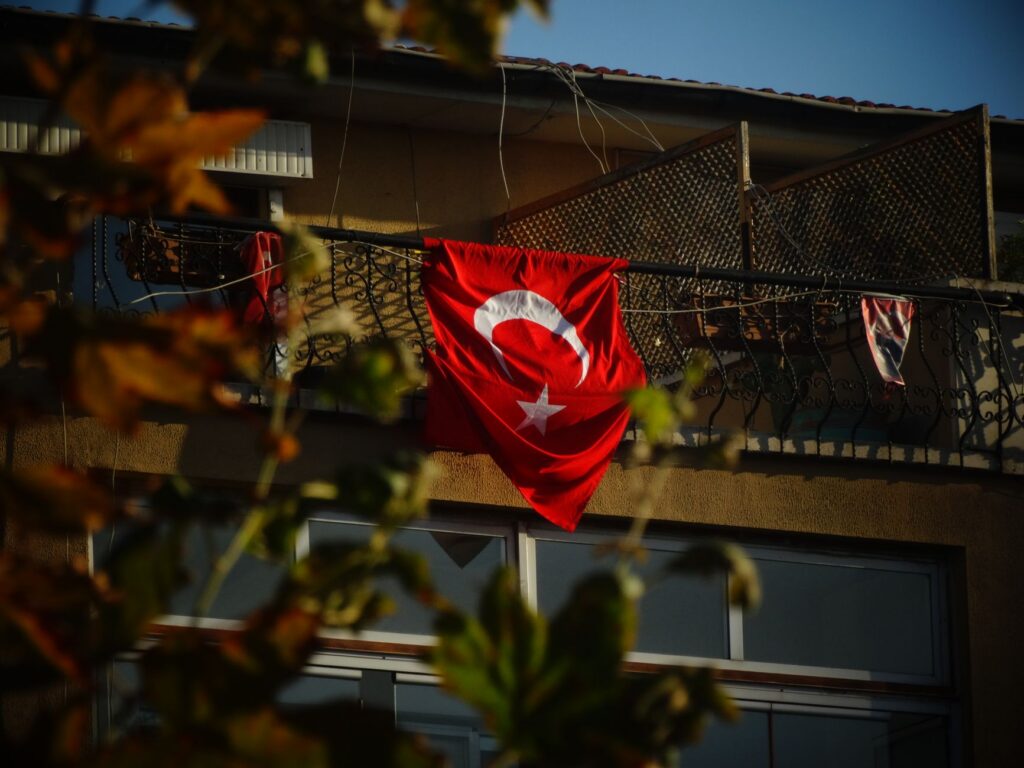
(This article was written by Derk Jan Eppink and appeared in Wynia’s Week. Trump moet straks om tafel met Erdogan, de grote winnaar in Syrië. Inzet: Wat gebeurt er met de Koerden?)
After the fall of Assad, Syria is back on the drawing board and ‘warlods’ are eyeing their chances for a land grab. After 53 years of rule over Syria the Assad family has packed its bags and Syria is ‘up for grabs’. Of course there is the frequently expressed wish to make Syria a democratically governed country with all rights for the various groups, on the basis of a constitution that holds human rights high. In the Middle East, wishful thinking unfortunately has a short life, and the hidden agendas are doubly thick.
The current situation is in a certain sense reminiscent of the end of the First World War when the British and French thought about the redistribution of the Ottoman Empire. The British politician and diplomatic adviser Mark Sykes (1879-1919) and the French diplomat François Georges-Picot (1870-1951) drew a few lines through the desert sand. A process that was beautifully described in a 2011 book: A line in the sand by James Barr. The colonial powers promised something everywhere: France and Great Britain got protectorates, there would be an Arab state and a Jewish one. The colonial powers served themselves first; the rest remained a question mark.
How will it turn out for Syria these days? A democratic state, a theocratic republic or a vassal of new masters. To be hoped for is naturally the first; to be feared are the other options.
In fact Syria was already divided up by Turkey, Russia and Iran, with president Assad the vassal of the latter two. UN resolution 2254 of 2015 called for Syria, mired in a civil war in what was called the ‘Arab Spring’, to be transformed into a ‘sovereign, independent, territorial and constitutional Republic’. Three contenders put themselves forward to work out that aim further in the ‘Astana process’, named after the capital of Kazakhstan: Turkey, Russia and Iran, under the leadership of UN envoy Staffan de Mistura.
There followed a variant on the ‘lines in the sand’: in 2019 Syria was divided into four ‘de-escalation zones’. The Syria of Assad, Russia and Iran immediately pulled 3 ‘de-escalation zones’ to themselves. For Turkey a zone remained in the northwest, along the Turkish border. There sat the Syrian opposition with around 4 million refugees, plus remnants of jihadi groups, including the Islamic State (IS), Al-Qaeda and al-Nusra, which united in Hay’at Tahrir al-Sham (HTS), under the leadership of Abu Mohammed al-Jolani.
Under his leadership and with the support of Turkey the rebels moved via Aleppo, Hama and Homs toward Damascus. The Assad regime was already greatly weakened because its pillars of support, Russia and Iran, had other worries on their minds. The Russian president Putin is stuck with Ukraine and Iran seems to be becoming a Goliath in the struggle with Israel. The fragile rule in Damascus became vulnerable. Erdogan sensed the moment well and supported HTS in the advance on Damascus, which perhaps proceeded more quickly than he himself had expected.
Erdogan can now work further on a Syria without Assad. His most important strategic target: the Kurds, a people without their own state. In Turkey around 15 million Kurds live, in Iran 8 million, in Iraq 6.5 million. In the latter country the Kurds have a sort of ‘special status’, a form of autonomy. The Kurds, around 75,000 of whom live in the Netherlands, fell by the wayside when the lines were drawn through the sand; they did not fit into the picture of the British and French.
The government in Ankara fears a strengthened Kurdish striving for independence in Turkey, the greatest nightmare for Erdogan. He does not want a Kurdish state in the neighborhood either. The Kurdish ‘autonomy’ in Iraq is bad enough for the Turks. No more of that.
Erdogan therefore does everything to thwart the Kurds. Turkey even set up a ‘Syrian National Army’ (SNA) that runs entirely on Turkish organization and armament. It is more of a mercenary formation. The Kurds, who in Syria are especially strong in the northeast, have set up the ‘Syrian Democratic Forces’ (SDF), which has the support of the United States. America has even stationed around 900 men in the region to help the Kurds.
That produces peculiar situations. If Turkey fires on the SDF, it fires on an ally of the United States and possibly hits Americans. These are thus two NATO countries in the desert, each on the other side of the line. Turkey has a total troop strength of 735,000 men; more than Germany and France combined. Turkey meets the NATO 2% norm with ease.
With the implosion of the Assad regime, the weakening of Iran and a Russia bogged down in trench warfare, Erdogan holds the strongest cards. From the United States he currently has little trouble, because president Biden is busy sorting out his family affairs and his wife Jill takes the honors, such as the reopening of Notre Dame.
Donald Trump takes office from 20 January 2025 and will, with his staff, have to delve into the dividing lines through the Syrian sand. He will have to sit down at the table with Erdogan: two ‘strong men’ together. Trump’s staff must first get some remedial lessons about Syria and its history.
And Iran? After Assad the biggest loser. The regime of the ayatollahs has lost the bridge to Lebanon, the ‘arc of terror’, and the rule in Tehran is becoming more isolated than ever. Hopefully the beard-men’s regime implodes; that would be an immense ‘game changer’. With the Iranian revolution of 1979 an enormous ordeal began, in Iran and beyond. It had just as disastrous an effect as the Russian revolution of 1917.
What is going to happen now? In 2011 I was among the observers on behalf of the European Parliament at the first free elections in Tunisia, where the ‘Arab Spring’ began. On the day I arrived, the Libyan leader Gaddafi was shot dead. Joy everywhere. A ‘new era’ would dawn. But it turned out differently. When the votes were counted, the fundamentalist Ennahda (Rebirth) turned out to become the largest party. Tunisia is meanwhile governed by a ‘strong man’: Kais Saïed. The ‘spring’ became winter.
In Syria there may come a constitutional consultation with many groupings, and much pressure from outside, with Turkey in the lead. In the ensuing process the most fanatical, radical and best-organized group usually wins. So possibly the ‘liberators’ of HTS. Important breaking point for Turkey: what role will the Kurds be allotted in Syria? Erdogan watches like a grey wolf.
Israel does not wait around. For safety’s sake it took control of some Syrian border areas, including the Syrian part of Mount Hermon. Anyone who has ever been on the Golan Heights sees the strategic importance of such positions. The Syrian fleet was preemptively destroyed, as were Syrian ammunition storage locations. Where in the Netherlands naïveté is experienced as disarming, in the Middle East it is deadly, as Israel found out on 7 October last year.
Of course I hope that Syria becomes a democratic state, but 14 years after the ‘Arab Spring’ not a single democracy has emerged in the Middle East. Israel is the only democracy in the region, not thanks to but in spite of the lines of the duo Sykes-Picot.
Derk Jan Eppink is a Distinguished Fellow (Honorary) at the Gold Institute for International Strategy, a Washington D.C.-based foreign policy and defense think tank.