
Each passing day seems to make this a matter of “when?” rather than “if”
Continue reading
Each passing day seems to make this a matter of “when?” rather than “if”
Continue reading
(This article was written by Adelle Nazarian and appeared in Newsmax. Autonomous Intelligence Could Mean Safer, More Effective Prisons)
Behind concrete walls and razor wire, a quiet technological revolution is underway in America’s prisons.
Autonomous AI agents are now surfacing actionable intelligence from text, audio, and video, alerting investigators, correctional staff, and law enforcement to emerging crises, prioritizing threats, and even writing and updating reports as new information arrives.
It’s happening because conservatives, and both Trump administrations, recognized that modernizing prisons through technology improves safety and health outcomes for inmates and officers alike, boosts rehabilitation and reentry, and strengthens public safety overall.
Automating labor-intensive work is critical given the severe shortage of correctional officers.
In an environment where a lapse in situational awareness can mean life or death, corrections departments can no longer afford to bury staff under paperwork and outdated protocols.
This urgency is compounded by a broader reckoning inside the Federal Bureau of Prisons.
The Trump administration has championed prison reform and modernization, emphasizing rehabilitation’s role in public safety.
Implementation of the First Step Act expanded home confinement and community placement for low-risk inmates with strong reentry plans, cutting costs and recidivism, a signature Trump-era achievement.
But determining who qualifies for these programs, and doing so quickly, requires risk and predictive analyses drawn from millions of data points, scattered across antiquated, siloed systems, case histories, medical logs, visitation and mail logs, incident reports, camera feeds, and more, alongside intelligence surfaced by newer technologies monitoring authorized inmate communications.
Congress has approved $5 billion in new BOP funding for staff retention, facility upgrades, and modernization. But that funding alone cannot hire officers fast enough or modernize facilities quickly enough to match the pace of reform.
Leadership needs a way to close that gap without waiting on staffing and construction timelines.
Existing tools that mine correctional databases for intelligence tend to work in isolation, producing fragmented information.
A system that flags an assault on camera, for instance, may be blind to what that same inmate said in a phone call earlier that day about planning the attack.
What’s needed is centralized intelligence that lets distinct systems and data silos work together.
That’s exactly what a new class of platforms, led by Leo Technologies (“LeoTech”), now provides, combining legacy data with newly derived intelligence into a single analytical system.
LeoTech’s Verus AI translates and transcribes authorized inmate communications in real time across 62 languages.
Using semantic AI, it understands context well enough to surface evidence of drug and human trafficking, planned violence, witness names, confessions, and suicidal ideation, sending continuous alerts to staff. It also performs link analysis and assists in report writing.
Verus AI is used in hundreds of jails and prisons nationwide, with over 13,000 users and analyzed over five billion minutes of communications over seven years. The Federal Bureau of Prisons, the nation’s largest system, recently awarded LeoTech a five-year contract to deploy Verus.
Verus Vision AI, meanwhile, uses a facility’s existing cameras to automatically flag warning signs, prolonged isolation, distress, gang proximity, concealed weapons, unauthorized movement, or gathering crowds, alerting staff within seconds.
It also automatically counts inmates, freeing up hundreds of thousands of staff hours for more important work: finding contraband, escorting inmates to medical and rehabilitation appointments, and human engagement that improves well-being and reduces recidivism.
LeoTech’s Verus ION, an agentic AI platform, unifies these capabilities, bringing together intelligence from correctional systems and external sources.
“Verus ION brings communications intelligence, video intelligence, institutional records and relevant open-source information into a unified operational picture,” said Steven Harpe, LeoTech’s Chief Product and Technology Officer.
“Its autonomous agents continuously evaluate those signals, identify relationships, prioritize emerging risks and route actionable information to the appropriate personnel… updating alerts, assessments and reports in real time.”
Alerts reach whoever is best positioned to respond: correctional investigators, medical staff, social workers, rehabilitation coordinators, internal affairs, or outside law enforcement. Importantly, these tools aid correctional staff; they do not replace human judgment or existing personnel.
In practice, this means an officer with a tablet can receive an alert about a planned contraband delivery and search a cell at the right moment, while ION simultaneously scans news and social media for related leads.
When an inmate alleges rape, relevant video and calls can be automatically preserved and surfaced for evaluation based on timing and proximity.
Dots that once went unconnected, and might have led to an attack, are now visible in time to prevent it.
“Centralized intelligence changes how a correctional institution operates,” Harpe said. “When information moves across systems in real time, leaders gain a clearer understanding of emerging risks and staff can devote more attention to work that requires human presence, experience and judgment.”
As the Trump administration continues to push prison reform forward, technologies like Verus offer the Federal Bureau of Prisons a practical way to close the gap between ambitious policy and the on-the-ground resources needed to execute it safely, turning information into action, and action into a safer, more rehabilitative correctional system for everyone inside it.
(Editor’s Note: The preceding column does not constitute an endorsement of any product or service on the part of Newsmax.)
Adelle Nazarian is a Senior Fellow at the Gold Institute for International Strategy, a Washington D.C.-based foreign policy and defense think tank.

(This article was written by Adelle Nazarian and appeared in The Western Journal. How One Congressional Resolution Could Save the Midterms: The GOP’s Hindu Vote Gamble)
The political landscape in America’s crucial suburban swing districts is undergoing a quiet but massive realignment.
For years, the Republican Party has made deliberate, strategic inroads with Indian American voters, a highly educated, affluent, and rapidly growing demographic whose core values of family, fiscal conservatism, and entrepreneurship naturally align with the GOP platform.
Yet, as the mid-term elections approach, this hard-earned momentum is hitting a dangerous roadblock.
There is an alarming wave of nativist, “Groyper” Christian extremist attacks targeting American Hindus. And if GOP leadership fails to denounce this specific brand of bigotry forcefully, they risk throwing away a historic opportunity to secure a vital voting bloc and to finally dismiss the narrative that suggests the Republican Party is racist.
The key to turning this around lies on the floor of Congress: co-sponsoring H. Res. 69, “Celebrating Hindu Americans, condemning attacks on Hindu places of worship, Hinduphobia, and anti-Hindu bigotry, and for other purposes,” a bipartisan resolution introduced to celebrate American Hindu contributions and explicitly condemn Hinduphobia officially.
When far-right agitators target American Hindus, they create an unstable vacuum, and the greatest beneficiaries are, ironically, radical Islamists and their extreme-left allies.
Historically and globally, Hindus and Indians remain the primary victims of Islamist aggression. Yet, when anti-Hindu incidents flare up across Texas and other parts of the country, Islamists expertly weaponize these moments. They use far-right bigotry as a shield to deflect public attention away from their own expansionist agendas.
Simultaneously, pro-Maoist, extreme-left factions exploit these attacks to pull Indian Americans into a superficial, highly manipulative “people of color” solidarity narrative.
In this carefully constructed leftist framework, the specific trauma and distinct identity of the American Hindu community are completely erased, rendering them subservient to the broader Islamist political agenda.
Look no further than the recent elections in Frisco, Texas, to see how this toxic dynamic plays out on the ground.
Frisco, a fast-growing Dallas suburb where nearly 20 percent of the population is of Indian origin, became a dark flashpoint for the party’s internal identity crisis. Far-right activists and outside agitators routinely descended on the town and even tore an Indian flag in a demonstration.
In the mayoral race, a candidate aligned with this extreme rhetoric openly vilified the immigrant population. The result was a decisive, self-inflicted defeat for the nativist camp. Suburban voters, including conservative-leaning Indian Americans who moved to Texas for safer neighborhoods and better schools, rejected the vitriol.
Frisco proved that anti-Hindu and anti-Indian bigotry is a losing political strategy in modern American suburbs.
The shifting allegiance of Indian American voters is backed by hard numbers. Polling data shows that Indian affiliation with the Democratic Party dropped by close to 10 percentage points between 2020 and 2024, with one in three Indians actively planning to vote Republican.
This shift is critical because Indian Americans are strategically concentrated in highly competitive, “purple” congressional districts where a few thousand votes decide the majority. In Texas districts like TX-22 and TX-24, the suburbs around Houston and Dallas-Fort Worth boast some of the highest concentrations of South Asian voters in the country, capable of tilting close suburban seats.
In Georgia’s GA-06 and GA-07, the Atlanta suburbs feature rapidly growing Hindu American populations that have already proven to be the deciding margins in statewide and federal races. Meanwhile, in Virginia’s VA-07 and VA-10, the tech-heavy corridors of Northern Virginia are filled with high-skilled Indian American professionals who vote at incredibly high rates.
If the GOP allows anti-Hindu and anti-Indian rhetoric to go unchecked, these voters will stay home or swing back left out of basic self-preservation.
By targeting American Hindus, who overwhelmingly enter the United States as highly skilled, law-abiding legal immigrants, the far-right unwittingly validates the extreme left’s entire worldview.
The hard left relies on a rigid “oppressor versus oppressed” dynamic. When highly successful, integrated American Hindus are subjected to xenophobic abuse, the left is handed an easy opening to legitimize and weaponize their narrative. They can smugly point to these attacks and argue that America is fundamentally and systematically unsafe for anyone who isn’t white.
By failing to aggressively police its own fringes, the GOP forces a highly conservative, naturally independent demographic right into the waiting arms of the progressive coalition.
Ultimately, passing H. Res. 69 isn’t just a matter of moral clarity. It is a political necessity.
By aggressively co-sponsoring the resolution, the GOP can signal to millions of American Hindus that their faith, their safety, and their contributions are valued. It cuts the legs out from under the left’s racial narratives, exposes the opportunism of Islamist organizations, and protects the precise suburban margins the GOP needs to secure the midterms.
Adelle Nazarian is a Senior Fellow at the Gold Institute for International Strategy, a Washington D.C.-based foreign policy and defense think tank.

(This article was written by Peter Huessy and appeared in the RealClearDefense. They’re Coming for the Military)
A number of Democratic Socialists of America party members have been campaigning on defunding the U.S. military. This is apparently part of an agenda that seeks to dismantle American military power which is seen as supporting an imperialist history with a colonial agenda. Particularly concerned are these candidates with American “business” investment overseas which they see as uniformly evil, just making “profits” and protected by U.S. militarism.
Two books in particular have made this view popular, especially among college graduates. The first was Franz Fanon’s 1961 “The Wretched of the Earth” and the second was the 1977 Lappe and Collins “Food First”. Fanon advocated violent revolution to end colonialism in the third world. Lappe and Collins argued that U.S. agribusiness reflected the worst form of colonialism and was creating the very violent revolutions the U.S. military was putting down.
Collins and Lappe (also the author of the widely popular “Diet for a Small Planet”) wrote that luxury crops grown by American agribusiness in third world nations was so extensive that it was stealing land that otherwise could grow subsistence crops for the poor. If planted with food and not luxury crops, the new land could produce enough food to literally wipe out hunger in the poorer nations of the world. Written soon after the Sahelian food crisis and the publication of “The Limits to Growth,” “Food First” was part of a Marxist narrative that U.S. business investment overseas was oppressive not beneficial. Including forcing people off the land, into crowded “favelas” and eventually forcing them to migrate north. “Wretched” explained that forced specialization in raw export crops was designed only to enrich the colonial powers, relied solely on plantation violence, and failed to feed the native citizenry. [Fanon’s book was cited by one U.S. President as having markedly affected his view of the role of the USA in the third world.]
In 1978 a study appeared in Ag World that examined such claims in remarkable detail. The study determined that in the third world land devoted to export luxury crops was at the time all of 29 million hectares. This amounted to around 3% of the then 890 million hectares (now 1.6 billion hectares) devoted to crop land, of which 97% was used for domestic food consumption. On top of which 100 million hectares, (now 200 million) of permanent crop land and 3.1 billion hectares of pastureland (now 3.6 billion hectares) were both also used for domestic food production.
Nonetheless, the narrative endured that “luxury” export crops including peanuts, cotton, coffee, sugar, and tobacco for example were being produced and exported from poor countries to rich nations. And as Lappe and Fanon argued, it was colonial agribusiness run by profit seeking oligarchs that were starving the oppressed.
Facts are all available from the Food & Agricultural Food Balance sheets [FA0] prepared by the United Nations which now details production, consumption, imports and exports for agricultural products worldwide for nearly 200 nations.
FAO’s data even back in 1978 illustrated that even if eliminated food and non-food ag exports to rich countries from the less developed world would have no beneficial impact on poverty or hunger. The export land at that time of the Ag World analysis accounted for only .7% of one percent of all agricultural land used in the poor nations of the world. Less than one percent more land wasn’t the solution to hunger. And remarkably, such a relatively small amount of land produced through free enterprise, some $300 billion in export earnings for third world nations around the world which the socialists would destroy, seriously harming the local economies.
In summary, in the poor nations of the world far more land (by a factor of 14,000 to 1) is used for domestic food consumption than luxury crop production for export to rich nations.
Obviously, the DSA types who think “free enterprise agriculture” and agribusiness are starving the world don’t even know the fundamental facts. They are convinced western white imperialists acting like colonialists are stealing top quality soil to grow luxury crops in poor countries for export to rich people in rich countries.
At that time, the coauthor of Food First even told me over lunch that the reports of “agrarian reform” causing deaths in Cambodia were widely exaggerated. But why was Collins defending Cambodia? Well from Chapter 4 in Food First there in black and white is a list of nations (all communist!) that reflect how to get food policy right: Cambodia, Ethiopia, North Korea, Cuba, China, Angola, Mali, Vietnam, and Guinea Basso. Even the USSR got an honorable mention as “at least reducing food inequality.” (Same paradigm comes up as DSA folks embrace Hamas).
Although collectively these national governments killed 80 million of their own people, Food First explicitly praised them. Even as these deaths have been documented by the Black Book of Communism published by the Marxist Institute in Paris after the collapse of the Soviet Union, the firm embrace of communism by the Food First authors was unmistakable. These nations, collectively, had in 1978 according to Ag World, the majority of the 29 million hectares of export crop land producing supposed luxury crops being exported to rich countries.
For example, Cuba grew sugar cane on 1.8 million hectares (1978) and sold the sugar to Moscow at 5 times the world price to make cheap vodka in Russia. China grew more than a million acres of tobacco to make cheap cigarettes to sell around the world. The very nations Food First praises for doing everything right were in fact doing precisely what Food First complained was causing hunger around the world!!
The reality? “Food First” was a complete fairy tale swallowed whole by the Washington Post and New York Times in glowing editorials praising the thesis of the book. They did the same with Fanon’s “The Wretched of the Earth.”
There’s one thing in common in the countries listed: with respect to their agriculture policies, they have killed millions of their own people. It’s not a coincidence. The DSA are selling the same stuff.
Peter Huessy is a Senior Fellow at the Gold Institute for International Strategy, a Washington D.C. based foreign policy and defense think tank.

The father of modern quasi elections on the hot seat, July 29, 2026
Continue reading
History is the best guide and gives a framework for Senate volatility that should set reasonable expectations
Last month, I wrote an article outlining the uphill challenge Democrats face in seeking to obtain a majority in the United States Senate. That article is open for all readers: End of June 2026 Senate Majority Race Update.
Here are the nine races that will determine which party wins the chamber majority:
Key Races
Second-Tier Races
Democrats could win all five key races, which I do not consider likely given the strength of Susan Collins in Maine, a developing race against a radical DSA-aligned candidate in Michigan, and the Sununu name in New Hampshire. But let’s say they do win them all. That would have Republicans in the lead 51 to 49, requiring Democrats to win two of Alaska, Iowa, Ohio, and Texas for a clear majority. They have a pathway to victory; but it’s not a realistic one.
Today, I have done the research and I’m going to demonstrate why I consider the Republicans a strong favorite to hold the Senate.
Trump 2024 Margins for Second-Tier Races
Alaska +13.1%
Iowa +13.2%
Ohio +11.2%
Texas +13.7%
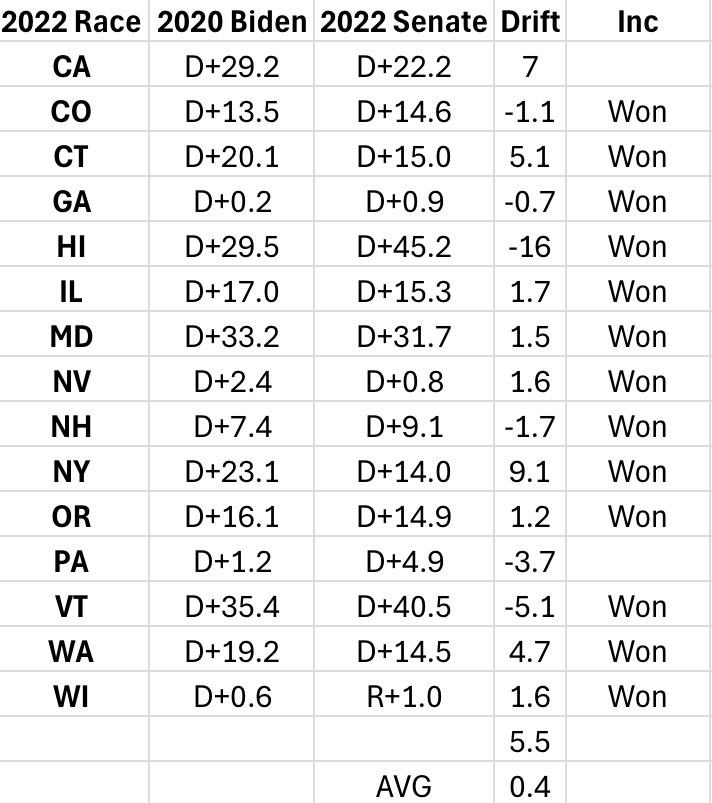
All analysis is from the perspective of the president’s party, given that we are facing a GOP-president midterm in November.
Here’s how to read the table above, using California as the example. In 2020, Joe Biden won California by a certified margin of 29.2% (yes, I know, it is artificially inflated). In 2022, the Democrat Alex Padilla won the Senate seat by 22.2%. That is seven points to the right of the 2020 presidential margin, indicated by a positive number in the “drift” column. Padilla was not an incumbent.
The table includes 15 Senate races, all in states Biden carried in 2020. The only state Biden won (“won” in this case) in which the Republican won in 2022’s Senate contests was Wisconsin, and incumbent Ron Johnson held his seat 1.6% right of the 2020 presidential margin.
Incumbents held 13 of 13 seats in Biden-won states.
9 of 15 seats had rightward drift from the 2020 presidential election.
Hawaii is the extreme outlier with leftward drift of 16.0%, driven by a weak Republican challenger to a strong Democrat incumbent (Schatz). Even keeping this outlier in the numbers, the average drift in these 15 Biden seats comes out to 0.4% rightward. This underscores why 2022 was a “pink trickle” rather than a red wave, and should help you understand why many are pondering if 2026 will be like a “reverse 2022” (Democrats expecting big gains but disappointed in outcome).
Hawaii excluded, none of the Senate seats won by the president had enough drift in either direction to flip any of the second-tier Senate races up in 2026.
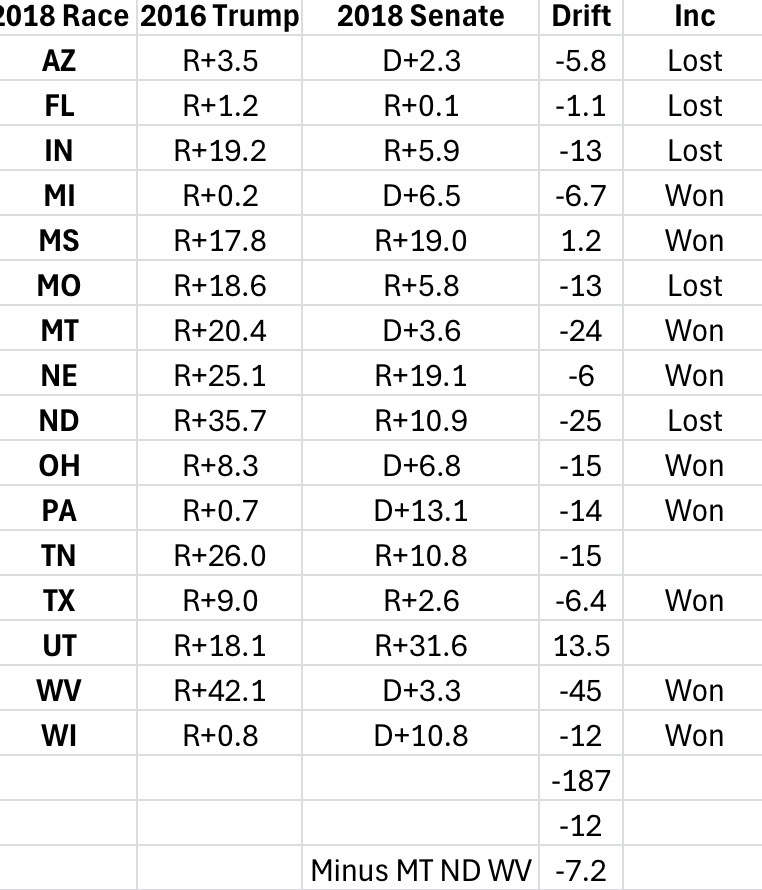
The 2018 Senate cycle appears ominous at first glance, given that 14 of 16 races ran left of the 2016 presidential margin and the presence of some really big drift numbers in Trump-won states. However, the GOP made a net gain in the Senate, driven by Rick Scott’s win over Bill Nelson in Florida, Mike Braun’s over Joe Donnelly in Indiana, Josh Hawley’s in Missouri over Claire McCaskill, and Kevin Cramer’s in North Dakota of Heidi Heitkamp. The latter three races, requiring the ouster of Democrat incumbents from Trump landslide states, had left drifts of -13.3%, -12.8%, and -24.8%, respectively.
Then there were the Democrats in similar races who managed to hold on, like Jon Tester in Montana running 24 points left of Trump’s 2016 margin, and Joe Manchin in West Virginia, at 45.4% left of Trump. Tester and Manchin are now gone, and with them, the blue dog coalition finds John Fetterman as its last surviving member (for now).
Pennsylvania, Ohio, and Wisconsin had big swings from Trump’s unexpected success in 2016, but Casey was a strong incumbent (out in 2024), Sherrod Brown held on for one last term, and so did Tammy Baldwin, who also almost lost in 2024. The fates of those three Senators (two former) suggest the overall electorate has adjusted since the 2016-18 timeframe and settled well to the political right, meaning the 2018 cycle was one of significant sorting.
Ken Paxton survives a 6.4% leftward drift in 2026 given Trump’s 2024 blowout in the Lone Star State, and Sherrod Brown would only win Ohio by 3.9% with the same differential he had in 2018 as an incumbent. My bet is he doesn’t have it in him.
Deducting extreme outliers Montana, North Dakota, and West Virginia, the 2018 Senate races in Trump-won states ran 7.2% left of presidential performance. All four second-tier states remain Republican with that differential this year, which is unlikely given the volatility of the Midwest in 2018 compared to today.
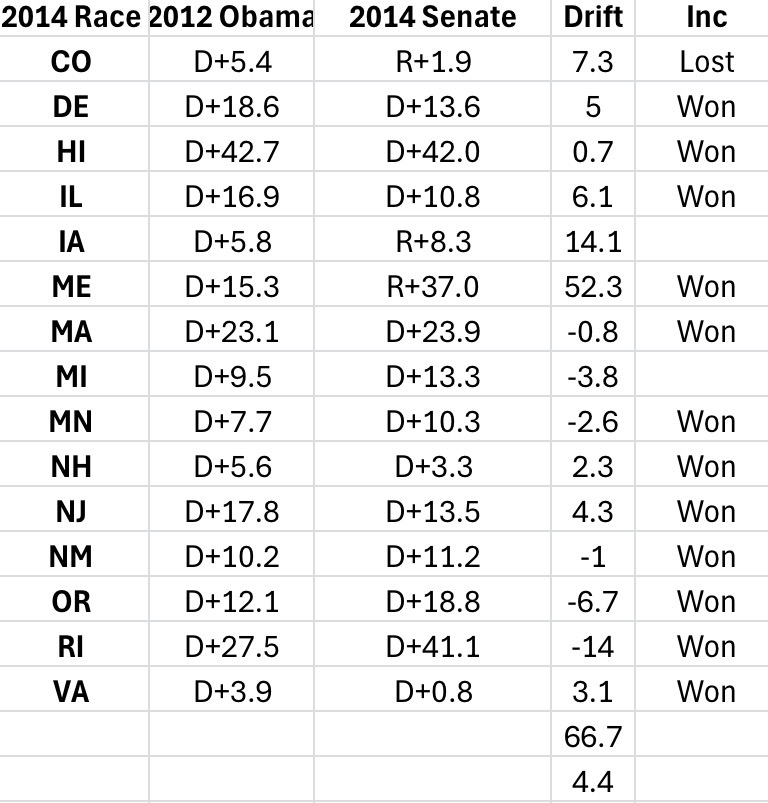
15 Obama-won states had Senate races up for grabs in 2014, a year marked by low turnout and a continuation of the 2010 Tea Party wave, but with a lot less volatility. Much of what the Rust Belt and greater Midwest would become was beginning to manifest in 2014, and we also got the last gasp of Republican Colorado here with Cory Gardner’s ouster of Democrat Mark Udall.
12 of 13 incumbents in Obama states won, including Susan Collins, who ran 52.3% right of Obama’s 2012 margin. She only needs to run 7.0% right of Harris’s 2024 margin to hold her seat in 2026.
Matching the 2022 midterms, 9 of 15 states had rightward drift in 2014 from the 2012 presidential election. Throwing out the extreme Collins outlier, the 2014 Obama-state Senate races had rightward drift of 1.1%.
Leftward drift can be expected in all four second-tier Senate races this year in Trump-won states Alaska, Iowa, Ohio, and Texas, on account of the president’s over-performances in all four in 2024.
Paxton is safe with Cruz’s 2018 differential, even if doubled.
Volatility in the Midwest has died off substantially since the first Trump midterm, and is likely to save Jon Husted (Ohio) and Ashley Hinson (Iowa), even though the latter is a non-incumbent.
Alaska doesn’t fit the pattern of volatile Midwestern state, and 2016 Trump states without a blue dog incumbent Democrat showed less volatility (Florida, Mississippi, Nebraska, and Texas as prime examples).
Democrats remain severe underdogs and need to sweep all five key races to have a puncher’s chance at the narrowest of Senate majorities.
Seth Keshel, MBA is a Senior Fellow at the Gold Institute for International Strategy and a retired Army Captain. He publishes Captain K’s Corner on Substack.

(This article was written by Trent Franks and appeared in the Epoch Times. Op-Ed: Sparing Our Children from a Nuclear Iran)
For approaching half a century, the world has borne witness as the Islamic Republic of Iran has, directly and through its terrorist proxies, murdered hundreds of Americans, thousands of Israelis, and tens of thousands of its own civilians, all the while maintaining a brazen and menacing march toward nuclear weapons with which to terrorize the world.
We have also observed the insane left under Presidents Bill Clinton, Barack Obama, and Joe Biden embrace policies that have allowed that relentless march to proceed.
The current Iranian regime is unalterably determined to delay, demagogue, falsify, and then ignore any honest implementation of any agreement they sign that would prevent them from eventually acquiring nuclear weapons.
They have so glaringly demonstrated for decades (up to this very hour) that their word means absolutely nothing. How can they possibly make this any clearer than they already have?
It is vital that the Trump administration and all Americans remember that the mullahs of Iran are not a traditional government as much as they are a ruthless religious cult whose unalterable mindset and primary reason for existence is the ultimate subjugation of all “nonbelievers” in the world.
In their pursuit of that end, apocalypse becomes an inducement rather than a deterrent.
Do we truly understand the potential reality of Iranian nuclear warheads being detonated in American cities?
Coherent Americans clearly understand that any outcome in Iran that ultimately allows the current cancerous regime to survive by the thinnest thread will be falsely hailed by them as a glorious victory and potentially allow them to come away with a tighter long-term death grip on their nuclear ambitions than ever before.
This entire equation could become even more relevant in light of the potential threat posed by Iran’s development of facilities beneath Pickaxe Mountain, which has heretofore been largely absent from the discussion.
Without American control of the Straits of Hormuz and the displacement capability of committed ground forces comprised of Iran’s own noble and freedom-loving people, the mullah government of Iran will attempt to run out the clock with convoluted, false pursuits of any pretend agreement, only to jettison it on the most capricious grounds when Donald Trump is no longer leader of the free world.
We should all remember that the Clinton administration negotiated a nuclear weapons agreement with North Korea, only to see it later vaporize, with the result being a nuclear-armed North Korea.
We should further remember that this same ideological mindset was responsible for the Joint Comprehensive Plan of Action, or JCPOA, in which the Obama administration financially empowered and placed Iran on a certain path to nuclear arms until Donald Trump intervened.
North Korea and Iran drastically differ in that one is a police state dedicated singularly to its own survival, and the other is an insidious theocracy zealously dedicated to the religious conquest of the human race.
Going forward, God help us all to understand that any military, economic, or political costs necessary to depose the current regime and their ravenous quest for nuclear weapons will pale in insignificance compared to the costs of dealing with such a regime or their ideological successors when they do possess nuclear weapons.
President Donald Trump has survived at least three assassination attempts, two preposterous impeachments, over 80 lawfare-driven indictments, and a demagogic hatred by the left that is simply unparalleled in American history.
Yet, he remains one of the very most consequential and successful presidents ever to occupy the White House. He may now be standing on the historic threshold that either defeats the evil ghouls currently leading the world’s most sinister sponsor of terrorism or allows them to stealthily slip past him into the hellish darkness of worldwide nuclear terrorism.
May Senate Republicans find the courage and wisdom to use the collective capability they currently possess to arrest this relentless Democrat obstruction and level the playing field in these fleeting moments before the midterm elections.
Moreover, for the sake of this and coming generations, may President Donald Trump find the courage and wisdom to finish his valiant and imperative quest to conclusively displace the malignant regime in the Islamic Republic of Iran.
Trent Franks was Vice Chairman of the Strategic [Nuclear] Forces Subcommittee in the United States Congress and called for Iran to be referred to the Security Council in 2005.
Congressman Trent Franks is a Fellow at the Gold Institute for International Strategy, a Washington D.C. based foreign policy and defense think tank.

Hermann Tertsch: Brussels stays silent as conservative and national forces are targeted across Europe, because Brussels itself foments the abuses.
Continue reading
The cases of Olfa Hamdi and Maria Maalouf expose a widening gap between America’s declared commitment to protect its citizens and refugees and its willingness to act when foreign governments weaponize legal systems against dissent. Hamdi, a U.S. citizen and Tunisian opposition figure, was detained in Tunisia after returning to the country and later became the subject of mounting concern from U.S. lawmakers and commentators who argued that she was being punished for political activity rather than ordinary criminal conduct. Maalouf, a Lebanese journalist living in exile in the United States, was sentenced in absentia by a Lebanese military court to 15 years in prison over speech critical of Hezbollah and Lebanon’s political order. The central point is not merely that two women faced abusive legal proceedings abroad. It is that the United States, despite a more developed policy language on wrongful detention and a longstanding legal commitment to shelter the politically persecuted, did not appear to respond with the urgency, visibility, or seriousness that either case should have demanded.
These cases differ in legal posture, nationality, and institutional setting, but they converge on one question: whether Washington will use the tools it says it possesses when allies, partners, or politically complicated governments target dissidents tied to America. The public record suggests that the United States has articulated a stronger policy on wrongful detention and the protection of vulnerable persons than it has been prepared to enforce in practice. That mismatch is not simply a messaging problem. It is a credibility problem that affects deterrence, diplomacy, and the broader perception of American resolve. The strongest way to understand these cases is therefore structural rather than episodic: they reveal an inconsistency between declared doctrine and operational behavior.
Tunisian authorities detained Olfa Hamdi at the airport on February 15, 2026, shortly after her arrival in Tunis. Hamdi, a U.S. citizen and leader of the Third Republic party, had repeatedly criticized President Kais Saied’s rule and called for a transitional government and early presidential elections. Her arrest is part of the broader repression of dissent that has accompanied Saied’s consolidation of power. The importance of the case lies not only in the detention of an American citizen, but in the political character of the detention itself. If a U.S. citizen can be jailed under such circumstances without a forceful and sustained response from Washington, the United States risks signaling that even its own nationals may receive only selective protection when the diplomatic environment is inconvenient.
That context matters because the United States has repeatedly framed wrongful detention not as an unfortunate byproduct of foreign legal systems but as a strategic abuse that can be used for coercion, leverage, or political punishment. The State Department explains that wrongful detention can involve cases in which a U.S. national is detained under circumstances indicating serious due process deficiencies, political motivation, or use of detention to influence the United States government. The Robert Levinson Hostage Recovery and Hostage-Taking Accountability Act (S.712 – 116th Congress) established the modern framework for determining whether a U.S. national is wrongfully detained abroad, and the State Department says that framework looks to factors including credible evidence of innocence, arbitrariness, denial of due process, and indications that detention is politically motivated or intended to influence U.S. policy. If the Hamdi case fits even part of that pattern, then it should have triggered a visibly robust response from the full range of U.S. institutions, not only routine consular engagement.
Rep. Joe Wilson, a Republican member of the House Foreign Affairs Committee, publicly denounced Hamdi’s arrest as “outrageous,” while Rep. Jason Crow, a Democrat, moved to co-sponsor legislation (Tunisia Democracy Restoration Act – H.R. 5101) calling for sanctions on Tunisia until democracy is restored. Rep. Chris Smith, also a member of the House Foreign Affairs Committee, raised Hamdi’s case alongside the detention of other Tunisian dissidents and warned that the arrests deepened concerns about civil liberties and judicial independence under Kais Saied. These interventions showed that Hamdi’s imprisonment was not being ignored on Capitol Hill. Yet congressional pressure, however important, is not the same as a coordinated executive response. The central problem is not that no one in Washington noticed; it is that the United States did not appear to convert congressional concern into a sustained public strategy proportionate to the detention of one of its own citizens. The absence of a clear and repeated executive message matters in diplomacy because public silence often becomes part of the political environment in which foreign governments calculate risk.
Maria Maalouf’s case is different in form but equally troubling in substance. The Jerusalem Post reported that a Lebanese military court sentenced Maalouf in absentia to 15 years in prison after remarks she made in a 2021 Israeli media interview criticizing Hassan Nasrallah and Hezbollah’s domination of the Lebanese state. Other reporting likewise described Maalouf as a journalist living in exile in the United States and one of several anti-Hezbollah media figures punished in absentia over their political speech. The use of a military court to impose a severe sentence for political expression is itself alarming. Equally troubling is Maalouf’s claim that she was not meaningfully notified and was denied a real opportunity to defend herself before sentencing, a circumstance that raises due process concerns even under the court’s own asserted legal framework.
Maalouf’s case should also be part of any serious American conversation with President Aoun about negotiations, normalization, and the future of Lebanon. While Beirut seeks U.S. support for diplomacy with Israel and a post-conflict political realignment, a Lebanese military court has sentenced a U.S.-based exile to 15 years in prison for speech that advocated the same broad direction: peace with Israel, resistance to Hezbollah, and a more sovereign Lebanese state. That is not a side issue. It is a measure of whether Lebanon’s governing order is genuinely prepared to move beyond Hezbollah’s coercive influence or is merely asking Washington to support diplomacy while preserving the domestic instruments of political intimidation.
Her case therefore implicates both freedom of expression and the right to fair proceedings. Although Maalouf is not a U.S. citizen, her presence in the United States as an exile or refugee gives the case direct relevance to U.S. law and policy. A foreign government’s decision to criminalize the speech of a U.S.-based political exile should not be treated as a distant matter, particularly when the speech concerns a U.S.-designated terrorist organization’s influence in the Middle East. The practical issue is whether refuge in the United States carries meaningful diplomatic protection when an authoritarian or captured judicial system attempts to project coercive power across borders. If the answer is uncertain, the deterrent value of American refuge is weakened for precisely the people U.S. law is meant to protect.
The current U.S. policy architecture is stronger on paper than many earlier frameworks. In September 2025, the White House announced an executive order to strengthen efforts to protect U.S. nationals from wrongful detention abroad. The White House said the order authorizes the Secretary of State to designate foreign states as State Sponsors of Wrongful Detention and to employ penalties that may include sanctions, visa restrictions, export controls, foreign assistance consequences, and related restrictions under existing law. Public reporting on the order likewise emphasized that it was designed to create punishments for countries that unjustly detain U.S. citizens and to raise the costs of this practice. The administration has also framed wrongful detention as a national-level policy concern rather than a narrow consular issue, with the State Department describing hostage-taking and wrongful detention as acts that undermine the rule of law and target Americans for political, financial, or strategic gain.
This policy detail is essential because it sharpens, rather than softens, the criticism in the Hamdi case. Washington cannot plausibly argue that it lacked a conceptual or legal basis for a stronger response when it has publicly described wrongful detention in precisely these terms and has advertised an expanded coercive toolkit. On paper, the United States possesses both the vocabulary and the instruments necessary to confront foreign abuses against Americans abroad. The unresolved question is whether those instruments will be used with consistency or only in cases that are already impossible to ignore.
The Maalouf case must be analyzed through a different but related legal lens: the protections the United States extends to refugees, asylees, and others who seek safety from persecution. U.S. Citizenship and Immigration Services states that refugee or asylum status may be granted to a person who has suffered past persecution or has a well-founded fear of future persecution on account of race, religion, nationality, membership in a particular social group, or political opinion. The asylum statute, codified at 8 U.S.C. § 1158, provides the legal basis for granting asylum to eligible applicants who are physically present in the United States or arriving at its borders. These protections are not merely formal. Asylum can permit a person to remain in the United States, obtain work authorization, pursue derivative protection for qualifying family members, and seek lawful permanent residence after one year. Even where asylum is unavailable, withholding of removal and protection under the Convention Against Torture may bar removal to a country where persecution or torture is more likely than not, though those forms of relief are narrower and do not offer the same benefits as asylum.
That legal structure does not automatically prevent all forms of transnational repression, but it does express a basic principle: the United States offers shelter because persecution on political grounds is unacceptable. When a foreign military court sentences a U.S.-based exile in absentia for political speech, that act collides directly with the underlying rationale of America’s refugee and asylum system. It tests whether the United States will treat refuge as a meaningful commitment rather than a purely domestic immigration status. This is why the Maalouf matter should be understood not as an eccentric foreign court ruling but as a challenge to the practical value of American protection for politically vulnerable people.
The inconsistency revealed by the Hamdi and Maalouf cases is therefore straightforward. In one instance, the United States has publicly committed to deter and punish the wrongful detention of its nationals abroad. In the other, U.S. law and policy recognize the need to protect individuals present in the United States from persecution tied to political opinion. Yet the public record in both matters suggests a restrained, low-visibility response rather than a forceful defense of either principle. This is the core thesis of the essay and the strongest basis for criticism: America’s declared protective doctrines are outpacing its willingness to operationalize them.
That gap matters because deterrence depends less on rhetoric than on observable consequences. If foreign governments conclude that Washington will reserve its strongest measures only for especially famous cases or for detentions by adversaries of the highest strategic salience, then the formal policy will not alter their behavior. Selective enforcement reduces the preventive value of the policy itself. Smaller states, fragile democracies, and hybrid regimes are often precisely the governments most likely to test the limits of U.S. resolve when they believe geopolitical considerations will mute the American response. The result is not only weaker deterrence but a broader invitation to use courts, detention, and in absentia proceedings as instruments of political intimidation.
There is also a normative cost. The United States regularly asks other governments to respect due process, free expression, and judicial independence. Those appeals carry greater force when Washington is willing to defend them in messy, politically inconvenient cases involving partners or countries that still maintain diplomatic relationships with the United States. When the response is quiet, delayed, or purely procedural, foreign elites may reasonably infer that U.S. principles are negotiable. Over time, that inference damages American credibility not only in human rights advocacy but in broader diplomacy, because commitments that appear selectively enforced are harder to take seriously.
A more serious U.S. response in Hamdi’s case would have begun with an unmistakable public determination that the detention raised wrongful-detention concerns under the Levinson Act framework. That should have been followed by sustained high-level diplomatic pressure, repeated public messaging, close coordination with Congress, and a transparent explanation of what costs Tunisia might face if the detention was not remedied. If the evidence supported it, the United States could also have considered the newer coercive tools publicized by the White House in 2025, including sanctions-related measures and restrictions linked to a formal wrongful-detention designation. Even if the administration stopped short of a formal designation, a visible escalation ladder would have demonstrated seriousness and helped restore deterrent value.
In Maalouf’s case, a substantive response would not depend on the wrongful-detention framework because she was not reported as a U.S. national. It would instead rest on a combination of diplomatic protest, public defense of freedom of expression, and a clear rejection of efforts by foreign military courts to criminalize the speech of U.S.-based exiles and refugees. Washington could also have used the case to articulate a broader policy against transnational repression, making clear that foreign governments may not exploit legal proceedings to intimidate dissidents who reside under U.S. protection. Such a response would have served not only Maalouf’s personal interests but the integrity of the American asylum and refuge system itself.
Such steps would not guarantee release in one case or reversal in the other. But foreign policy credibility is shaped as much by visible effort as by final outcomes. A government that says it will protect Americans and the persecuted must be seen trying with urgency and consistency, especially when the abuse is tied to political dissent. This is why the issue should matter even to observers who disagree on the personalities involved or on the wider politics of Tunisia and Lebanon. The principle at stake is whether legal coercion directed at an American citizen or a U.S.-based political exile will carry meaningful diplomatic consequences.
These cases should be understood not as isolated humanitarian episodes but as part of a larger contest over whether legal systems can be weaponized to suppress dissidents across borders. Wrongful detention, politicized prosecutions, in absentia convictions, and military-court proceedings are different legal instruments, but they often serve the same political end: punishing critics while preserving a thin appearance of legality. That is precisely why U.S. policy must connect citizen protection, anti-hostage diplomacy, and anti-transnational-repression measures into a coherent doctrine. Without that coherence, individual cases will continue to be handled in ad hoc fashion, and foreign governments will continue to infer that the United States distinguishes between principles it proclaims and principles it is prepared to defend.
For Tunisia, the lesson is that democratic backsliding should not be insulated from consequences merely because the country occupies a complicated place in regional diplomacy. For Lebanon, the lesson is that the use of military courts and politicized legal proceedings against critics of Hezbollah should carry diplomatic repercussions, especially when those critics reside in the United States. For Washington, the larger lesson is that credibility erodes when policy instruments are advertised broadly but deployed sparingly. These are not marginal concerns. They go to the heart of whether the United States still intends to match legal principle with strategic action.
The cases of Olfa Hamdi and Maria Maalouf are linked by more than timing or geography. They reveal a structural contradiction in American statecraft: the United States increasingly speaks the language of protection, accountability, and opposition to politically motivated repression, yet too often responds cautiously when called upon to defend those principles in practice. Hamdi’s detention tests whether Washington will vigorously protect its own citizens abroad, while Maalouf’s sentence tests whether refuge in the United States comes with meaningful resistance to foreign political persecution. If the United States wants its warnings about wrongful detention and political persecution to be taken seriously, it must act as though credibility is itself a strategic asset. That requires more than quiet diplomacy and general concern. It requires a visible willingness to impose costs, defend dissidents, and demonstrate that America’s legal and moral commitments are not merely aspirational slogans but operational principles.
Eli M. Gold is the President of the Gold Institute for International Strategy, a Washington, DC based think-and-do tank

Embattled governor can’t throw everyone else under the bus fast enough to cover for the rest of the blue wall
Continue reading