(This article was written by Ernie Audino and appeared in RealClearDefense. How Not to Turn Iran into Vietnam)
It’s not by heeding the tired, old line that Americans don’t tolerate casualties. We do. We just don’t tolerate casualties for something of little value. And it’s not that the war with Iran is for something of little value, because there’s nothing more dangerous than a nuclear ayatollah. It’s by way of political leadership that decides why we initiated combat on Iran, and what we want out of it. If a president is uncertain of his political objective, how on Earth can the generals prosecute a strategy to achieve it? They can’t.
It largely comes down to a clear understanding of politics’ role in war.
Consider the West’s most influential theorist on war, Carl Von Clausewitz, who explains it well: “No one starts a war — or rather, no one in his senses ought to do so — without first being clear in his mind what he intends to achieve by that war and how he intends to conduct it. The former is its political purpose; the latter it’s operational objective.”
During the Vietnam War, no clear, strategic objective drove our operations. Battlefield commanders (and a nation) were left asking:
Is it to contain Soviet or Chinese communism?
Is it to defeat North Vietnam?
Is it to defend South Vietnam?
Is it to defeat an insurgency?
Moreover, our inability to understand a comprehensible objective in Vietnam meant our citizens could not attribute a high value to it. Without that, no nation will muster sufficient domestic support to do what’s necessary to win, nor endure what’s required to achieve victory. Again, Clausewitz says it best: “Since war is not an act of senseless passion but is controlled by its political object, the value of this object must determine the sacrifices to be made for it in magnitude and also in duration.”
And so, with little domestic support for the war in South Vietnam, there was certainly no support for our taking the war to North Vietnam to destroy the North Vietnamese Army (NVA), the center of gravity (COG) for our enemy’s ability to operate. Consequently, we never went on the strategic offensive to achieve outright victory and imposition of our terms, choosing instead a limited war that incorporated civilian theories of economics. We saw limited war as a way to bargain. We even applied to it a novel, smart-sounding term, “graduated response,” which pin-striped advocates asserted would progressively “signal” to the north that we meant business and in turn motivate them to negotiate.
It signaled just the opposite…that we didn’t have the will to win.
No will to win, no hope of imposing our terms. No chance for victory.
Unfortunately, we’ve charted a similar course with Iran. Let’s start with our strategic objective. After the uprising began in December, the President said, “Help is on the way.”
Did that mean our objective was to topple the regime? Many interpreted it that way.
Was our objective, “total surrender”? The President said it was.
Was our objective a permanently non-nuclear Iran? After all, he did say he would not allow Iran to possess a nuclear weapon.
Is our objective now to reopen Hormuz? Or is it to close Hormuz with a blockade?
Maybe it’s just to get Iran to agree to another ceasefire?
Should that first-order confusion remain, our generals can brilliantly accomplish their operational objectives, and they have, yet our nation will never transform that into strategic, political success. So far, our military has downed every aircraft in the Iranian air force. We’ve sunk every warship in the Iranian navy. We’ve destroyed a staggering amount of Iran’s drones and ballistic missiles and launchers, and we’ve disrupted Iran’s entire defense industrial base. And yet, the regime remains hostile. Given that we’ve not violently imposed our will on the enemy, no one should be surprised that we’ve been unable to demand terms and achieve political success.
But here’s the inexplicable part – we then unilaterally chose to cease combat and try bargaining. Our adversary presented no compelling military reality to cause us to stop fighting, but we chose to stop just the same and negotiate. We chose not to violently end the regime’s nuclear weapons ambitions, but somehow, we told ourselves they’ll do it now, because we’re asking them politely. We chose not to force open the Strait of Hormuz, but we subsequently expected to do that with a signature. To be sure, we simultaneously signaled more painful strikes in the future, but just as in Vietnam, this does not signal a will to win. Worse, when we hit Iranian assets during our self-imposed ceasefire, we sometimes were quick to communicate that it was done in self-defense. It’s almost like we were apologizing.
There’s no question that we adopted a strategic defensive, but that can only make sense for us if time is not of the essence. Clausewitz observed that those who adopt the defense assume that the situation will improve over time if they just wait for it.
The irony is our situation with Iran is NOT improving, and we don’t have all the time in the world to wait. We’ve proffered an endless series of negotiations. We’ve engaged in repeated, humiliating supplications. The conditions didn’t change. The behaviors didn’t change. Yet, somehow, we expected a different result lurked just around the corner. Meanwhile, the calendar continued scrolling to the right, toward our mid-term elections.
President Trump now says the ceasefire is over. Good. So, rather than repeat our strategic missteps in Vietnam, how do we learn from them?
Let’s start with the objective. Not only must it secure for us a vital national interest (in this case, a permanently non-nuclear Iran), but its great stakes and high value must be clearly understood by American citizens. The duty to make that case resides with the president. It’s his responsibility to convince us that it’s worth fighting for, and it’s worth winning.
Unfortunately, destroying Iran’s air force can’t win it by itself. Neither will sinking all their boats. Nor will destroying the drones and missiles and defense industrial base. And gaining a signature on a piece of paper sure can’t do it. Only a stated objective to end the Islamic Regime can generate a suitable effort capable of terminating Iran’s ambition to build or acquire a nuclear weapon. So far, President Trump has ruled out ending the regime.
Should he change his mind, ending the regime won’t happen by magic. It will require the transition of all elements of national power to the strategic offensive, something we were unable to do in Vietnam, but something entirely possible in Iran. In 1967 that would have required bringing the decisive fight to Hanoi to destroy the enemy’s COG, the North Vietnamese Army. Today our enemy’s COG is the Islamic Revolutionary Guards Corps (IRGC). Its remaining hardliners must be brought to the psychological tipping point where they conclude that their survival as an organization is no longer inevitable, and that their physical destruction is likely. They must be brought to the point where they fear the Iranian population more than the population fears the regime’s levers of repression and internal control. To the apocalyptic core of the IRGC, costs incurred are irrelevant, but losing the ability to physically control the population is not.
Iranian citizens overthrew a regime in 1979, and they did it without the support of the world’s greatest superpower. They can do it again in 2026, but they cannot do it today without a major power first setting conditions on the ground for them. They cannot do it without close air support. And they WILL NOT do it without hearing President Trump say his objective is to topple the regime and commit to a strategic offensive to accomplish it.
And he must mean it.
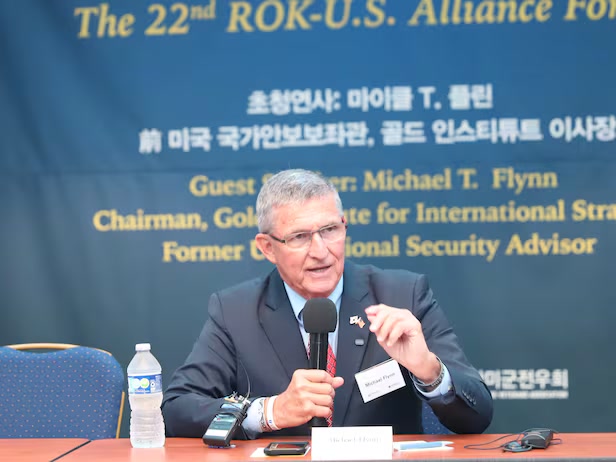
Brigadier General Ernie Audino (US Army, ret.) is a Senior Military Fellow, Kurdistan Program (U.S. Chair) at the Gold Institute for International Strategy, a Washington D.C. based foreign policy and defense think tank.