Executive Summary
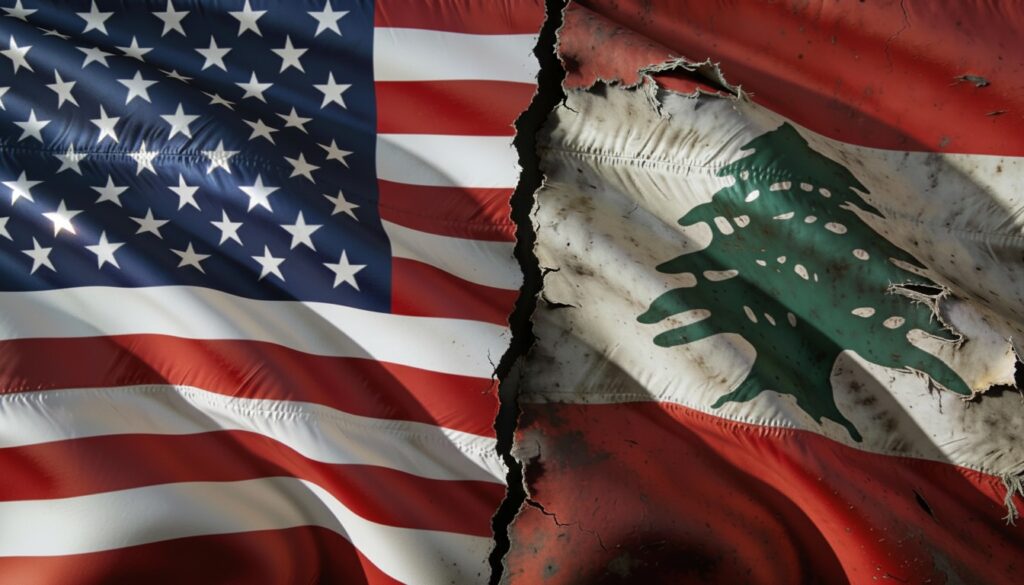
Lebanon in 2025 has reached a stage of structural collapse that now shapes how Washington, Riyadh, and other international actors evaluate the country’s strategic relevance. The decision by the Trump administration to cancel all scheduled meetings for Lebanese Armed Forces (LAF) Commander Rodolphe Haykal in Washington constitutes a pivotal indicator of this reassessment. This study examines the strategic implications of this diplomatic shift, contextualizes it within Lebanon’s internal security developments—including the arrest of Nouh Zeiter and the assassination of Hayssam “Abu Ali” Tbatabai—and analyzes how these events reinforce the perception of Lebanon as a state fully compromised by Hezbollah’s influence.
I. Strategic Context of the U.S. Recalibration
The cancellation of Haykal’s Washington engagements reflects a U.S. determination that Lebanon no longer functions as a neutral or independent actor within the regional system. The American position is informed by the persistent inability of Lebanese institutions to assert sovereignty or implement security obligations, particularly those related to dismantling illegal armed networks. The withdrawal of political recognition from the LAF is therefore not a tactical decision but part of a broader shift in how Washington interprets Lebanon’s alignment and credibility.
Concurrently, the “Beirut One” economic forum underscored the international consensus regarding Lebanon’s deteriorating governance. Foreign investors stated directly that economic recovery is impossible without the consolidation of state authority, the restriction of weapons to legitimate institutions, and the implementation of structural reforms. This external feedback reinforces the U.S. conclusion that Lebanon’s governing system remains unwilling or unable to initiate sovereignty-reinforcing measures.
II. Internal Security Indicators and the Erosion of Hezbollah’s Control
Lebanon’s internal security landscape revealed significant indicators of shifting power dynamics in 2025. The arrest of Nouh Zeiter, a major narcotics figure long considered protected by political and militia networks, demonstrated an unusual operational success by the Lebanese Army Intelligence Directorate. The arrest, executed without resistance, raised questions regarding the withdrawal of protective cover and whether certain factions within Hezbollah’s environment are weakening. Regional security actors have noted that the LAF’s recent ability to disrupt cross-border narcotics operations aligns with a pattern of reduced militia oversight in some localities.
A more consequential indicator was the targeted killing of Hayssam “Abu Ali” Tbatabai, a high-value Hezbollah commander with a standing American bounty. The rapid exploitation of a security lapse leading to his assassination signaled a deeper Israeli penetration of Hezbollah’s operational ecosystem. This event highlighted structural vulnerabilities within Hezbollah’s command-and-control networks, as well as growing discontent within its base, particularly among communities fatigued by continuous mobilization in service of Iran’s regional agenda. The assassination suggests that Hezbollah now faces second-generation attrition, marking an evolution in Israel’s long-term strategy to degrade the organization.
Together, these internal developments—Zeiter’s arrest and Tbatabai’s elimination—support the assessment that Lebanon’s coercive landscape is no longer monopolized by Hezbollah and that the party’s ability to maintain absolute control over its internal environment is visibly eroding.
III. Lebanon’s Institutional Unraveling and the Loss of Credibility
Lebanon’s institutional collapse remains the central factor driving international policy recalibration. Economically, the country continues to suffer from currency destruction, banking paralysis, capital flight, and minimal investor confidence. Demographically, Lebanon endures sustained emigration, the depletion of professional sectors, and the political marginalization of core communities, including a shrinking Christian presence. Politically, the paralysis of parliament, cabinet dysfunction, compromised judiciary, and constrained security institutions have rendered the state incapable of executing fundamental governance responsibilities.
Within this framework, Washington no longer distinguishes between the Lebanese state and Hezbollah’s decision-making apparatus. Foreign policy positions, including those related to Gaza, the Gulf, and U.N. engagement, are broadly understood to reflect Hezbollah’s strategic preferences rather than state interests. Consequently, the LAF is no longer perceived as an independent partner capable of enforcing United Nations Security Council Resolution 1701 or counterbalancing militia authority.
IV. Regional Dynamics and the Repositioning of U.S. and Saudi Policy
Lebanon’s marginalization is further entrenched by the emergence of a new regional architecture anchored by the United States, Saudi Arabia, Israel, Jordan, Egypt, and the UAE. This axis prioritizes stability, investment flows, counterterrorism, and technological cooperation. Lebanon remains structurally outside this framework due to its alignment with Iran’s regional networks. Tehran’s continued use of Hezbollah, Iraqi militias, Syrian auxiliaries, and Yemeni Houthis to project influence has reinforced the U.S. conclusion that Lebanon cannot be stabilized under its current political configuration.
Border tensions between Hezbollah and Israel intensify Washington’s perception of Lebanon as a security threat rather than a stabilizing partner. The downgrading of the LAF’s political engagement in Washington must be interpreted within this regional security lens.
V. Strategic Scenarios for Lebanon’s Trajectory
Given these converging factors, three strategic pathways are emerging in policy discussions:
1. Escalation of targeted sanctions against political, economic, and militia-aligned actors, with a focus on financial disruption and political isolation.
2. A coordinated U.S.–Saudi pressure framework that conditions aid, supports sovereignty-oriented political actors, and seeks partial restructuring of Lebanon’s security sector.
3. A controlled collapse leading to reconfiguration, potentially involving decentralized governance, federal models, or international trusteeship if national institutions become fully nonfunctional.
The combination of diplomatic downgrades, internal security shifts, and regional realignments strongly suggests that external actors are preparing for a post-Hezbollah or post-status-quo political order, regardless of Lebanese internal resistance.
Conclusion:
Lebanon’s 2025 trajectory reflects a profound crisis of sovereignty, institutional capacity, and strategic alignment. The U.S. cancellation of the LAF Commander’s Washington meetings is emblematic of a deeper determination that Lebanon, under current conditions, cannot operate as an independent state or credible partner. Simultaneously, the arrest of Nouh Zeiter and the assassination of Hayssam Tbatabai underscore structural vulnerabilities within the militia-state ecosystem and reveal shifts within Lebanon’s coercive environment.