Gold Institute Hosts H.E. Robie Kakonge, Ambassador of the Republic of Uganda

Gold Institute Ambassador Dinner Series invitation for the private dinner with H.E. Robie Kakonge, Ambassador of the Republic of Uganda

On the evening of July 15th, the Gold Institute for International Strategy hosted a private dinner with H.E. Robie Kakonge, Ambassador of the Republic of Uganda to the United States and to the World Bank, the International Monetary Fund, and the International Telecommunications Satellite Organization. President Eli M. Gold hosted the evening for a select group of guests, among them business leaders representing several countries, a representative of the World Bank, and members of leading policy organizations.

The intimate setting allowed for a candid conversation with the Ambassador on Uganda’s economic trajectory and its emerging role as a strategic commercial gateway in East Africa. The discussion was held under the Chatham House Rule to encourage a frank and open exchange. Ambassador Kakonge outlined the specific areas where the country is seeking serious private-sector partners, offering guests a direct view of Uganda’s priorities and the opportunities taking shape across its economy.

The discussion spanned a broad range of priority sectors, including infrastructure and construction, energy and extractives, manufacturing and industrial development, value-added agriculture, financial services and fintech, information and communications technology, tourism, logistics and transportation, healthcare, and education. Together, these sectors reflect Uganda’s comprehensive growth strategy and its effort to harness one of the youngest and fastest-growing populations in the world.

For the business and policy leaders in attendance, the evening offered an opportunity not only to better understand Uganda’s priorities, but also to explore how practical, mutually beneficial partnerships might be structured in the years ahead.

The dinner reflected the Gold Institute’s continuing commitment to convening serious leaders for substantive dialogue on the economic and strategic questions shaping international partnerships.

President Eli M. Gold welcomes Ambassador Robie Kakonge to the Gold Institute private dinner

Ambassador Robie Kakonge is welcomed by President Eli M. Gold.
Ambassador Robie Kakonge speaks with guests during the Gold Institute dinner

Ambassador Robie Kakonge discusses Uganda’s economic priorities with guests.
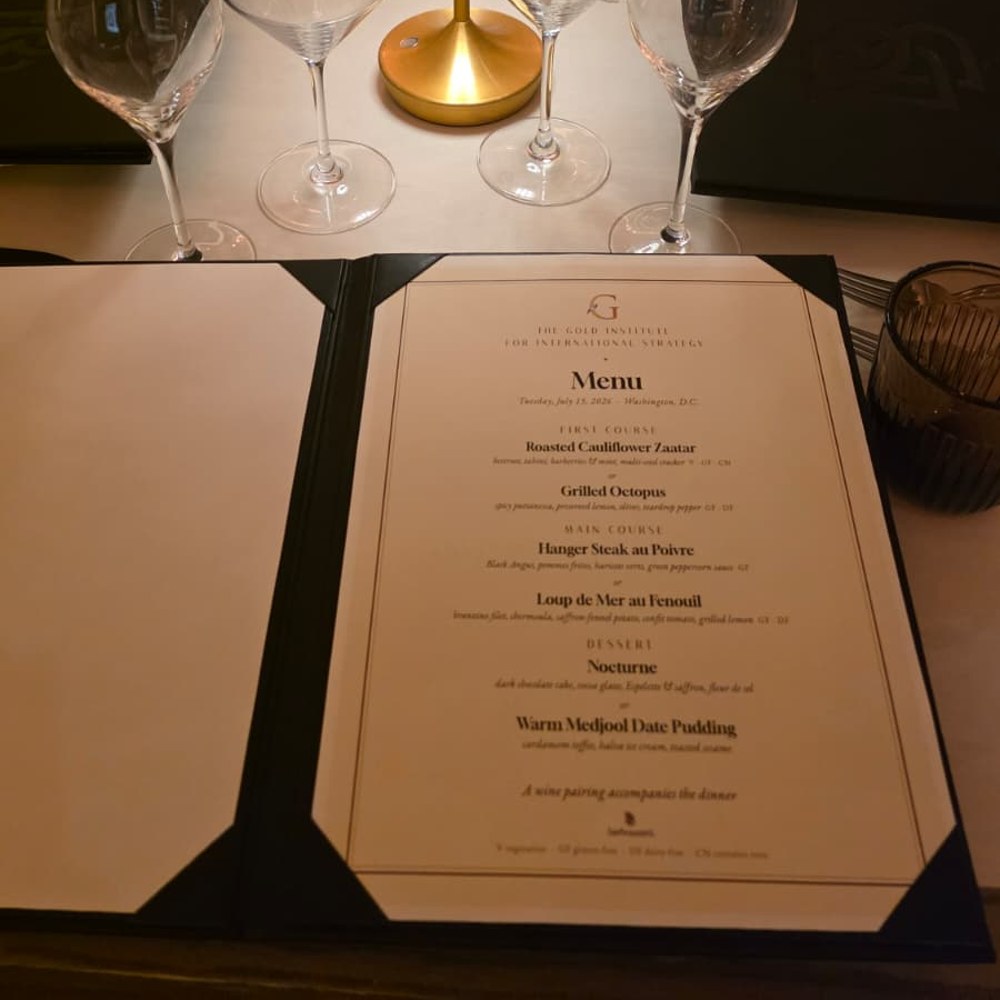
The evening's menu at the Gold Institute private dinner

The evening’s menu.

How Not to Turn Iran into Vietnam

U.S. Navy warships and aircraft transit the Arabian Sea

(This article was written by Ernie Audino and appeared in RealClearDefense. How Not to Turn Iran into Vietnam)

It’s not by heeding the tired, old line that Americans don’t tolerate casualties. We do. We just don’t tolerate casualties for something of little value. And it’s not that the war with Iran is for something of little value, because there’s nothing more dangerous than a nuclear ayatollah. It’s by way of political leadership that decides why we initiated combat on Iran, and what we want out of it. If a president is uncertain of his political objective, how on Earth can the generals prosecute a strategy to achieve it? They can’t.

It largely comes down to a clear understanding of politics’ role in war.

Consider the West’s most influential theorist on war, Carl Von Clausewitz, who explains it well: “No one starts a war — or rather, no one in his senses ought to do so — without first being clear in his mind what he intends to achieve by that war and how he intends to conduct it. The former is its political purpose; the latter it’s operational objective.”

During the Vietnam War, no clear, strategic objective drove our operations. Battlefield commanders (and a nation) were left asking:

Is it to contain Soviet or Chinese communism?
Is it to defeat North Vietnam?
Is it to defend South Vietnam?
Is it to defeat an insurgency?

Moreover, our inability to understand a comprehensible objective in Vietnam meant our citizens could not attribute a high value to it. Without that, no nation will muster sufficient domestic support to do what’s necessary to win, nor endure what’s required to achieve victory. Again, Clausewitz says it best: “Since war is not an act of senseless passion but is controlled by its political object, the value of this object must determine the sacrifices to be made for it in magnitude and also in duration.”

And so, with little domestic support for the war in South Vietnam, there was certainly no support for our taking the war to North Vietnam to destroy the North Vietnamese Army (NVA), the center of gravity (COG) for our enemy’s ability to operate. Consequently, we never went on the strategic offensive to achieve outright victory and imposition of our terms, choosing instead a limited war that incorporated civilian theories of economics. We saw limited war as a way to bargain. We even applied to it a novel, smart-sounding term, “graduated response,” which pin-striped advocates asserted would progressively “signal” to the north that we meant business and in turn motivate them to negotiate.

It signaled just the opposite…that we didn’t have the will to win.

No will to win, no hope of imposing our terms. No chance for victory.

Unfortunately, we’ve charted a similar course with Iran. Let’s start with our strategic objective. After the uprising began in December, the President said, “Help is on the way.”

Did that mean our objective was to topple the regime? Many interpreted it that way.

Was our objective, “total surrender”? The President said it was.
Was our objective a permanently non-nuclear Iran? After all, he did say he would not allow Iran to possess a nuclear weapon.
Is our objective now to reopen Hormuz? Or is it to close Hormuz with a blockade?
Maybe it’s just to get Iran to agree to another ceasefire?

Should that first-order confusion remain, our generals can brilliantly accomplish their operational objectives, and they have, yet our nation will never transform that into strategic, political success. So far, our military has downed every aircraft in the Iranian air force. We’ve sunk every warship in the Iranian navy. We’ve destroyed a staggering amount of Iran’s drones and ballistic missiles and launchers, and we’ve disrupted Iran’s entire defense industrial base. And yet, the regime remains hostile. Given that we’ve not violently imposed our will on the enemy, no one should be surprised that we’ve been unable to demand terms and achieve political success.

But here’s the inexplicable part – we then unilaterally chose to cease combat and try bargaining. Our adversary presented no compelling military reality to cause us to stop fighting, but we chose to stop just the same and negotiate. We chose not to violently end the regime’s nuclear weapons ambitions, but somehow, we told ourselves they’ll do it now, because we’re asking them politely. We chose not to force open the Strait of Hormuz, but we subsequently expected to do that with a signature. To be sure, we simultaneously signaled more painful strikes in the future, but just as in Vietnam, this does not signal a will to win. Worse, when we hit Iranian assets during our self-imposed ceasefire, we sometimes were quick to communicate that it was done in self-defense. It’s almost like we were apologizing.

There’s no question that we adopted a strategic defensive, but that can only make sense for us if time is not of the essence. Clausewitz observed that those who adopt the defense assume that the situation will improve over time if they just wait for it.

The irony is our situation with Iran is NOT improving, and we don’t have all the time in the world to wait. We’ve proffered an endless series of negotiations. We’ve engaged in repeated, humiliating supplications. The conditions didn’t change. The behaviors didn’t change. Yet, somehow, we expected a different result lurked just around the corner. Meanwhile, the calendar continued scrolling to the right, toward our mid-term elections.

President Trump now says the ceasefire is over. Good. So, rather than repeat our strategic missteps in Vietnam, how do we learn from them?

Let’s start with the objective. Not only must it secure for us a vital national interest (in this case, a permanently non-nuclear Iran), but its great stakes and high value must be clearly understood by American citizens. The duty to make that case resides with the president. It’s his responsibility to convince us that it’s worth fighting for, and it’s worth winning.

Unfortunately, destroying Iran’s air force can’t win it by itself. Neither will sinking all their boats. Nor will destroying the drones and missiles and defense industrial base. And gaining a signature on a piece of paper sure can’t do it. Only a stated objective to end the Islamic Regime can generate a suitable effort capable of terminating Iran’s ambition to build or acquire a nuclear weapon. So far, President Trump has ruled out ending the regime.

Should he change his mind, ending the regime won’t happen by magic. It will require the transition of all elements of national power to the strategic offensive, something we were unable to do in Vietnam, but something entirely possible in Iran. In 1967 that would have required bringing the decisive fight to Hanoi to destroy the enemy’s COG, the North Vietnamese Army. Today our enemy’s COG is the Islamic Revolutionary Guards Corps (IRGC). Its remaining hardliners must be brought to the psychological tipping point where they conclude that their survival as an organization is no longer inevitable, and that their physical destruction is likely. They must be brought to the point where they fear the Iranian population more than the population fears the regime’s levers of repression and internal control. To the apocalyptic core of the IRGC, costs incurred are irrelevant, but losing the ability to physically control the population is not.

Iranian citizens overthrew a regime in 1979, and they did it without the support of the world’s greatest superpower. They can do it again in 2026, but they cannot do it today without a major power first setting conditions on the ground for them. They cannot do it without close air support. And they WILL NOT do it without hearing President Trump say his objective is to topple the regime and commit to a strategic offensive to accomplish it.

And he must mean it.

Brigadier General Ernie Audino (US Army, ret.) is a Senior Military Fellow, Kurdistan Program (U.S. Chair) at the Gold Institute for International Strategy, a Washington D.C. based foreign policy and defense think tank.

Is America Going to Full Scale WAR?

Dear America,

Never forget that in warfare the enemy has a vote & they also have spies everywhere, to include inside the very decision making systems we believe we control.

Additionally, don’t take our eyes off Russia nor any of the “watch” conditions surrounding China’s actions. Our actions (or lack of them) equate to their strategic counteractions (all sides).

Then what are the strategic indicators that a nation is about to go to full scale war?

Key signs a nation is preparing for full scale war include sudden military mobilization, stockpiling supplies, heightened cyber activity, & aggressive rhetoric from leadership. Watch for diplomatic evacuations, sanctions buildup, or unusual troop movements near borders. These often signal intent before shots are fired.

Russia & Ukraine are well past these steps.

We need to ask the question, what is China’s posture just across the straits of Taiwan?

Does America have all the options in place for our success there (ie., if we decide to go full scale into Iran)?

Does movement of strategic assets such as NUCLEAR weapons, ballistic weapons, large-scale logistics capabilities indicate additional scaling up of major WAR preparation?

Movement of these type capabilities is one of the strongest indicators & there appears to be some of these indicators in Russia. When you see NUCLEAR or ballistic missile repositioning, especially to forward bases or hardened sites, this is among the strongest indicators of escalation intent. Large-scale logistics like fuel convoys (especially unusual types of fuel), ammunition trains, or hospital ship deployments signal sustained conflict prep, not just posturing. When you see all three together, it’s rarely a bluff. However, sustaining the sustainers is a monumental task for any nation.

Have we pre-positioned any military or strategic assets that indicate total war in and around the Persian Gulf? Are we ready for a breakout in the Pacific?

In the Middle East, the answer is YES. The U.S. has significantly reinforced the Persian Gulf with at least two carrier strike groups, with their dozens of destroyers, Marine expeditionary units, additional fighter squadrons, & mine countermeasures ships.

This buildup, the largest since 2003 (pre-invasion of the disastrous Iraq invasion), supports ongoing operations against Iran, with forces positioned for sustained combat, blockade enforcement, & potential escalation. No public evidence of NUCLEAR weapons movements, but the scale of conventional assets signals high readiness for major conflict.

Are there any U.S. Marine or Army logistics units that have been deployed to the Middle East (these are major indicators for ground operations)?

At least two Marine Expeditionary Units have deployed to the region with their full logistics combat elements for self-sustainment. Reported Army units like elements of the 82nd ABN and others are there too, which always bring attached sustainment & logistics support. No standalone large Army logistics units have been publicly flagged, but the overall force posture in the ME is robust.

Assume our President has all this information as well as many other strike & sustainment packages required for large scale Middle East operations.

Are we prepared elsewhere around the world or do we only possess a one Major Regional Conflict military?

Decades of sustained WAR & deterioration & diminishment in the ranks of key leaders for slog it out type warfare are questions our nation MUST address.

WARs (or Stupid Wars), once engaged (and we are fully engaged in the ME & are in close contact in Eastern Europe & in the Pacific region), MUST achieve victory at all costs. Any other outcome will change the strategic direction of the United States forever.

Our nation MUST pray for our President & peace. However, if America is placed in a position where we MUST fight, then we MUST win.

There are no other acceptable outcomes.

Michael T. Flynn, LTG USA (Ret.) is the chairman of the Gold Institute for International Strategy, a Washington, DC-based think-and-do tank.

Storm Clouds Gather Around Thursday Night

Four possible courses of action tied to the president’s address

President Trump is set to address the nation tomorrow evening on a matter of grave importance. Leaks and media coverage are all over the place, but they seem to have the range dialed in: election interference. Be mindful that engagement seekers online are willing to throw out anything to catch your attention – “this is about Georgia’s senators,” or “they found the hackers” and similar comments are everywhere. Until we hear from the man himself, all bets are off.

To my wonderful subscribers here, please understand I have no choice but to keep things at surface level today. Friday, should there be no change in plans in scheduling or plan (delayed speech, etc.), you can expect a full review of exactly what is made known to the public, with no obligation for me to continue to be cagey. As such, this article is shorter than most; still, given the subject matter, it is of vital national importance.

President Trump’s address tomorrow, assuming it provides evidence of catastrophic breaches, vulnerabilities, or interference pertaining to our election infrastructure, stands to bring out any combination of four outcomes:

I. Nothingburger

“If the left really thought a nothing burger was coming down the pipe Thursday night, they wouldn’t be using up so much damn energy trying to get in front of it, or coordinating their messaging across the entire Uniparty network of oxygen thieves.” — Seth Keshel (@RealSKeshel), July 14, 2026

The odds of this being a nothingburger or “rug pull” along the lines of digital trading cards are approximately zero percent. You can tell just by watching the preemptive defensive tactics adopted by media and leftists. We’ve heard from both Georgia senators, who were in fact illegitimately elected in 2020 when David Perdue and Kelly Loeffler, despite finishing first on November 3, 2020, were artificially held below 50% and forced into runoffs, which both Democrats “won” on January 5, 2021. Whipped dogs yelp the loudest, I’m told.

In any case – a nothing burger would leave us where we are today – waiting for the next break in a court, or for the Senate to do something. The problem for the uniparty and their media water carriers is that this scenario is about as likely as the Republican nominee dropping Idaho to Kamala Harris in 2028.

II. Emergency Orders

If the president unveils irrefutable evidence that foreign powers interfered in our elections, or has the capacity to interfere in our elections (including databases, infrastructure, and/or actual voting systems), this could compel Trump to use national security powers, or any agency involved in what is being declassified to act within their statutory authority. My friend Joseph DeMott suggested an interesting course of action that doesn’t seem too far off-base:

“Let’s see if my Trump gut still works. I think Trump is going to declare of state of emergency on Thursday leading into the Save Act that was stapled to the Defense bill in the house today.” — Joseph DeMott (@josephdemottx), July 15, 2026

This feeds conveniently into the third point…

III. SAVE Momentum

Yesterday, House Republicans advanced the text of the SAVE America Act to the Senate as part of defense-funding legislation by a vote of 215 to 211. From The Hill:

The 215-211 vote delivers a key win for Speaker Mike Johnson (R-La.), who had spent weeks trying to unify his conference as conservative hardliners pressed leadership to take more aggressive action on the Safeguard American Voter Eligibility (SAVE) America Act and legislation to codify President Trump’s border policies.

There have already been rumblings that the Republican “surrender caucus” may be willing to bite the bullet in honor of Lindsey Graham to get the SAVE America Act in the rear view mirror. Compelling evidence of our election systems being compromised will provide one hundred times more pressure on the Senate to act than we’ve been able to muster thus far (and that has been a lot of pressure).

IV. Narrative: Ruined

Christopher Krebs must be on a boat to some isolated nation, given that he is the guy who gave us the lie of “the most secure election in American history” to describe the 2020 quasi election. We’ve been assured that anyone challenging the 2020 election, or any other garbage since like the Kari Lake race or Spencer Pratt’s primary effort, is arguing in bad faith and simply suffers from poor sportsmanship.

Since we were all told to believe everything the government had to say about the 2020 election so far, and were persecuted into complying with COVID-19 tyranny based on junk science and magic eight ball shakes, then I would imagine the government coming out with new documentation regarding the state of our election infrastructure must be unimpeachable, right?

It all depends on what kind of proof is made public – but I dare say the narrative of “American elections are fraud-free” is on the ventilator right now, preparing for the plug pull.

Conclusion

I wish I could say more. Media will spin and find loopholes, but I’d wager the damage has been done for good if it is made public that our elections are susceptible to outside interference. If intrusions are not only possible, but documented, we are likely to see unprecedented action taken to provide needed public confidence that we are indeed represented by a government of, by, and for the people.

Remember: Trump hasn’t given up the fight for free and fair elections, and neither should you.


Seth Keshel, MBA is a Fellow at the Gold Institute for International Strategy and a retired Army Captain. He publishes Captain K’s Corner on Substack.

The NY Primaries Were a Wake-Up Call: How Radical Islamist Alliances Have Captured the Democratic Base

Voter casting a ballot with an American flag in the background

(This article was written by Adelle Nazarian and appeared in the The Western Journal. The NY Primaries Were a Wake-Up Call: How Radical Islamist Alliances Have Captured the Democratic Base)

The recent New York Democratic primary results reveal more than typical political turnover. They expose a dangerous realignment within the American Left. What we’re witnessing is the systematic mobilization of Islamist organizations forging strategic alliances with democratic socialists and far-left activists, creating a powerful coalition that threatens the party’s traditional center.

The deliberate targeting and defeat of Assemblymember Jenifer Rajkumar exemplifies this troubling trend. As a moderate Democrat and the first South Asian woman elected to the state legislature, Rajkumar embodied the pragmatic wing of her party.

Her loss wasn’t an isolated upset. It represents part of a coordinated effort to purge moderate voices from Democratic politics. Across New York, we’re seeing well-funded insurgent campaign machines systematically target and eliminate centrist Democrats, replacing them with candidates who embrace increasingly radical positions.

In this highly charged new political landscape, American Jewish and Hindu communities have been uniquely vilified, alienated, and targeted. Longstanding peaceful minority groups who have contributed immensely to the fabric of New York are being pushed to the margins as the radical left consolidates power.

This is not organic grassroots politics; it is an engineered and highly strategic takeover.

Behind the rise of these socialist Democrats is a deeply concerning geopolitical web: Pakistan and Qatar-backed Islamist elements, propped up and sustained by the vast network of the global progressive ecosystem.

To understand the depth of this crisis, one must look at the specific institutions driving this radical alignment. Far-left socialist Democrats have entered direct tactical alliances with institutions linked to Jamaat-e-Islami (JeI), which is now often referred to as the new Muslim Brotherhood.

These JeI-linked mosques and organizations are not mere community centers; they are extensions of an ideological movement with a dark, violent history.

Jamaat-e-Islami-linked factions were directly responsible for horrific atrocities during the 1971 genocide in Bangladesh, which disproportionately targeted Hindus. They have a documented history of ideological and material support for terrorist organizations like Hamas, which was responsible for the Oct. 7, 2023, massacre in Israel.

Anyone suggesting the massacre was retribution for the “occupation of Israel” is an accomplice to terrorism and should be monitored closely by the West.

The fact remains: The dangerous nature of this network is not a matter of partisan speculation. It has already caught the attention of federal lawmakers.

House Resolution 1140 explicitly acknowledges the severe threat posed by Jamaat-e-Islami elements, highlighting their involvement in radicalization, terror finance, and foreign interference that directly undermines domestic security and liberal democratic norms.

Confronting this reality requires immediate, targeted action from both sides of the aisle. The political center cannot hold unless both parties step up to address this dangerous realignment.

For Republicans, there is an urgent, tactical necessity to work tirelessly to expose the deep-seated influence of Jamaat-e-Islami within local and state politics.

For too long, the GOP has treated far-left victories as simple ideological differences over taxes or spending. They must realize this is a foreign-backed national security concern operating right on American soil.

By shining a relentless spotlight on these radical ties, conservatives can effectively fracture the progressive coalition, isolate the socialist Democrats, and defeat them at the ballot box.

Republicans must make JeI’s record a central talking point, demonstrating to independent and moderate voters that the modern far left has aligned itself with the perpetrators of historical atrocities and active terror networks.

For mainstream Democrats, the party faces a defining moment of existential risk. The defeat of moderate voices like Rajkumar proves that the radical wing is no longer content to sit at the table. They want to take over the House.

Democratic leadership must immediately engage in deep introspection and find the moral courage to vocally speak up against the infiltration of JeI-linked groups into their base.

Mainstream Democrats must reject endorsements, campaign funds, and alliances tied to these radical networks. Failing to do so will mean the utter alienation of traditional, moderate voting blocs, including the Jewish and Hindu American communities, and the complete transformation of the Democratic Party into a vessel for extremist ideologies.

It also means working within the party to defeat Democratic incumbents who are pushing the agenda of these Islamist groups before our very eyes in the halls of Congress.

If both mainstream political parties fail to take active steps to dismantle this alliance, the radical realignment witnessed in New York will soon become the national standard.

To avoid the risk of falling into the same fractures currently destabilizing the United Kingdom, Germany, Italy, Spain, Sweden, and France, both sides of the aisle must act before the damage is irreversible.

Republicans must relentlessly expose and dismantle this extremist network, while Democrats must decisively purge it from their ranks to take back control of the American political center.

Adelle Nazarian is a Senior Fellow at the Gold Institute for International Strategy, a Washington D.C. based foreign policy and defense think tank.
The Trump-Graham Alliance and the Future of the Vacant SC Senate Seat

The death of Lindsey Graham brings all-new challenges for the Trump coalition

Unless you’ve been living under a rock somewhere in the desert (which may be preferable some days depending on the news cycle), you are certainly aware that South Carolina’s senior U.S. Senator, Lindsey Graham, died Saturday night after returning to Washington, D.C., from a trip to Ukraine. This led to the typical range of responses online when someone prominent dies, ranging from reflective, to poetic, to downright evil.

Before I get further into what it is I’d like to discuss today, the timeline of American political life has always fascinated me. Just as I find it fascinating that President John Tyler (our tenth president!) had grandchildren who lived well into the 21st century, I find it fascinating that Graham’s seat, which he held since 2003, had only been held by one other man since 1956. That man was the notorious Strom Thurmond, who switched his party affiliation to Republican from Democrat in 1964, the year of the Goldwater revolution (and a terrible national landslide for Lyndon Johnson).

Suffice it to say that Graham had been a Washington, D.C., fixture for a long time. Even longer when we consider his time in the U.S. House. Whether you liked Graham or not, this is a big deal, just as it will be a big deal when Mitch McConnell vacates his seat in the near future. The MAGA coalition is made up of the most ideologically diverse Republican group ever assembled. It includes the following:

  • Old Guard Republicans (“Reaganites”)
  • Neoconservatives (dwindling)
  • Evangelicals/Social Conservatives
  • Trade populists
  • Reformed libertarians
  • Other loosely aligned groups committed to outsiders like Trump only

This naturally means these factions are in constant competition (and conflict) with one another, and younger members of the alliance who don’t bolt for the doors struggle to reconcile their views with that of the old world – which Graham belonged to. Graham, as we all know, was very hawkish and came into conflict with President Trump over his views of foreign policy. He was also soft on illegal immigration and was an early critic of Trump’s heavy-handed proposals; yet he remained someone the President valued until his last breath.

I’m here to tell it like it is. It doesn’t mean you have to like it, and it most certainly doesn’t mean I even agree with the President, or anyone else’s, view of the entire matter – but let me help you understand why Trump looked past his differences with Graham and why there are now many unresolved issues related to his unexpected passing:

I. Obstacle or Not?

Every time there is a Supreme Court pick awaiting confirmation, or there is a life-or-death issue like the SAVE America Act up for a vote, every patriot in the world starts counting on their fingers:

  • Murkowski
  • Collins
  • McConnell
  • Curtis
  • Tillis
  • Plenty of Senate alumni such as Flake, Romney, Alexander, Cornyn and any other squishes looking to appease everyone

All of a sudden, that 53-seat majority doesn’t sound so great. We need 75 senators to get around the drama, back-stabbing, and uniparty scamming going on in Washington. One of my favorite subscribers brought up his grievances with Graham yesterday related to January 6, and his points are valid. Graham was very harsh over January 6 and critical of Trump, and I wouldn’t be surprised if he regrets going as far as he did.

Yet…when is the last time you remember counting Graham in that group you just knew would be parroting sexual assault claims against a judicial nominee or ignoring the fact that a bill has 75/25 support because it was intended to fix a nationally known crisis? That’s right.

Trump values loyalty.

From The Hill:

“This is a big blow to the SAVE America Act, let me tell you,” Trump told Welker.

Trump said he spoke with Graham earlier Saturday night, saying the late senator had just landed from Ukraine and told the president, “We’re all set for the SAVE America Act.”

“He sounded a little tired but perfect, but a little bit tired, and had a right to be,” Trump continued. “He was a worker; he was really a worker. But he sounded great, actually, but he actually said he was tired. But he wanted to pass the SAVE America Act, and I said, ‘We’re going to get it done, Lindsey, we’re going to get it done, I’ll see you, like soon. We might even meet today.’”

Graham, although overly hawkish on foreign policy (which most of the young MAGA coalition opposed him over), was rock-solid on judicial nominees – slamming home Gorsuch, Kavanaugh, and of course, Amy Coney Barrett just ahead of the 2020 election with all of its headwinds and media insanity. He also was instrumental to the Trump agenda in his role in the next point:

II. Senate Budget Committee Chairman

Put the first point together with this one. Why do you think Graham, the chairman of the Senate Budget Committee, was knocking on Trump’s door right at the very end over the SAVE America Act? That’s because the chatter from the Republican Congress has been about pushing that legislation across as part of a reconciliation bill, tying it to government cheese and big dollars.

“Hey, Lisa – you want that bridge in the Aleutians? It’s going to be in this next bill.”

“Thom, the people of North Carolina are counting on you!”

Politics is an ugly thing but it is a real thing. I’m married to a Freedom Caucus member who is all too willing to die on the hill of ideology but inevitably realizes, when necessary and appropriate, that not all hills must be died upon and that the long-term battles are the most important. Graham’s role in advancing Trump’s fiscal priorities, such as tax policy, through the Senate were and are instrumental to growing the MAGA economy:

Sen. Lindsey Graham (R-S.C.), who died late Saturday, served as one of the Senate GOP’s most trusted channels into Trump’s orbit, translating the president’s demands to skeptical senators while explaining the realities of the Senate back to the White House.

“He could go in and get something approved,” Trump said Sunday on NBC’s “Meet the Press,” reflecting on Graham’s political skills. “He would just get people on his side. … I wouldn’t often ask, but if I had a problem with a Democrat he could work it out.”

III. If It Ain’t Broke…

Graham, at odds with many in the MAGA movement and a Senator with soft base support, nevertheless was one more incumbent with no concerns over a possible General Election upset. The left thought they had him in 2020, and here’s how that turned out:

For what it’s worth, South Carolina (as opposed to Georgia and North Carolina) has more of a Florida effect going on. Whereas Horry County (Myrtle Beach) was worth a margin of +33,242 for Romney in 2012, it was worth +79,394 for Trump in 2016; transplants to South Carolina are overwhelmingly Republican. This will have the same impact as it does in Florida, where I can view party registration, in that there is no blue wave the new red electorate cannot absorb.

Graham’s immediate replacement will be chosen in a special GOP primary set for August. That individual will take on left-wing whack Annie Andrews in November as an incumbent. Nikki Haley (thank God) is reportedly out, but Trey Gowdy, Nancy Mace, Mark Lynch, and Ralph Norman are kicking the tires on a run.

“Since Lindsey Graham’s last wish was the Save America Act, he should be replaced by a no nonsense freedom lover like Ralph Norman who will make sure that gets done.” — Tyler Bowyer (@tylerbowyer), July 12, 2026

All of those Republican candidates would win a General Election – even Mace, who makes everything about herself and apparently didn’t take the hint after a fifth-place finish for governor last month in the GOP primary.

Conclusion

Politics is a complicated world. Sometimes when we wonder why our favorite team’s general manager keeps that light-hitting catcher on the team, jeopardizing a strong offense, we find ourselves enlightened when we find out the future Hall of Famer on our pitching staff prefers to pitch to him, and not the guy who can hit (this was the case when I was a kid and Greg Maddux only wanted to pitch to Charlie O’Brien, rather than Javy Lopez, who could hit).

Graham’s value to Trump was not ideological, nor was it because he shared all of Trump’s views on immigration and foreign policy. In fact, they were opposites in many ways; yet Graham received Trump’s blessing because he was a necessary piece for advancing less glamorous policies through the Senate. Politics is the art of what is possible, and Graham’s death now provides ample opportunity to get the wrong person in office.


Seth Keshel, MBA is a Fellow at the Gold Institute for International Strategy and a retired Army Captain. He publishes Captain K’s Corner on Substack.

July 2026 Voter Registration by Party Updates for Key 2026 and 2028 Battlegrounds

Close-up of hands holding a vote ballot, symbolizing election participation

Author’s Note: For a summary of why voter registration by party is so important, and to understand the importance of these states and why each were selected for this recurring study, please see the March 2025 summary.

Last month’s report can be found here.

FLORIDA

Net Shift Since June: R+13,479

  • Good news for Democrats – they had a healthy gain in registrations for the first time in recent memory. Now, the bad news – they still got passed up by a factor of 2.2 to 1 by the Republicans as both parties surged ahead of the upcoming primary. There is no way to describe what is happening to Democrats in the Sunshine State because there is no comparison to this anywhere else in the country – it is a Republican onslaught month after month and people need to start moving to coastal Georgia or the hills north of Atlanta.
  • Florida’s drift is predictive for Pennsylvania and Michigan since 1952, portending good things for future GOP campaigns in both of those battlegrounds in the next presidential election. Florida appears to be emerging as the premier GOP superstate, passing Texas (although not in order of importance by electoral votes and House seats).
  • Races to watch: FL-14 (leaner), FL-22 (leaner), FL-25 (decisive)

IOWA

Net Shift Since June: D+10,005

  • Yep, read that one again. Last month showed the first real gain for Democrats since I’ve been tracking these numbers, and this month brought a huge one, dropping the GOP lead from R+10.8% to R+10.2%. However, this jump is far too drastic to be anything but directly related to the recently concluded primary and should begin to taper back to reality. For comparison’s sake, the GOP gained 17,238 last month and still fell this far behind because independents showed up to pick a party (-33,983 for independents). Democrat energy in a midterm provided the difference.
  • Iowa is worth tracking because it has a valid correlation to the shifts in Wisconsin and Minnesota, which cannot be precisely tracked by party registration. Furthermore, Iowa has two extremely competitive House seats that must be watched closely.
  • Races to watch: IA-1 (decisive), IA-3 (decisive), U.S. Senate, Governor

PENNSYLVANIA

Net Shift Since June: D+6,962 Total, R+2,197 Active

  • The best news out of the Keystone State in months. With primaries concluded, Republicans made up 2,197 net in the active voter roll. Don’t ask me why there is such a disparity in the overall voter roll (Democrat gain) and the active roll, but I’m tracking both just to keep reconciling these figures.
  • Republicans made net gains in 20 of 67 counties since before the primaries started, including in the all-important blue collar bellwethers of Erie and Northampton Counties. There does not appear to be a major realignment back toward Democrats underway despite recent Democrat gains, as most gains were concentrated in heavily urban areas.
  • Races to watch: PA-1 (leaner), PA-7 (decisive), PA-8 (decisive), PA-10 (decisive)

NORTH CAROLINA

Net Shift Since June: D+482 Total, D+2,206 Active

  • Rough month for North Carolina Republicans, but early July updates suggest they’re inching back to gains. Democrats gained 2,206 net on the active roll, but have still fallen far behind where they were in the November 2024 election, when Trump won by 3.2%.
  • With former Democrat Governor Roy Cooper running for U.S. Senate, Republicans need all the help they can get. I consider the GOP-held seat in North Carolina the most likely to flip to Democrats in 2026, with Michael Whatley the Republican nominee.
  • Races to watch: NC-1 (leaner), U.S. Senate

NEW HAMPSHIRE

Net Shift Since June: No Update

  • New Hampshire releases quarterly updates, and no update is due until August.
  • The Granite State remains the most likely Republican flip for the 2028 presidential election.
  • Races to watch: NH-1 (leaner), U.S. Senate

ARIZONA

Net Shift Since June: No Update

  • I can view registrations change weekly in Pima County and around-the-clock in Maricopa County, but am now shifting this model to update on official Secretary of State releases, which come quarterly. This is to ensure the whole picture is painted, rather than having you see it through glimpses – which can either be overly encouraging or discouraging in these incomplete blips. I had expected Secretary of State Fontes to publish party registration figures by now, but will have to wait until August to analyze them in this monthly release.
  • Democrats have been making up significant ground in Maricopa County with primaries around the corner (July 21), but I suspect that is the why here – not a long-term reversal of electoral trend. Arizona’s statewide offices are up for grabs this year, and the Democrats have a real shot at flipping the legislature for the first time since the 1960s, so the battle for voter registration looms large.
  • Races to watch: AZ-1 (decisive), AZ-6 (decisive), all statewide offices

NEVADA

Net Shift Since June: D+4,111

  • Democrats have narrowly flipped the party registration lead back from Republicans in what has been a back-and-forth power grab multiple times since the 2024 election. Republicans actually had a nice month, but Clark County carried Democrats to a net pickup of 4,111. The state sits a half-point right of its registration index from when Trump carried the state by 3.1%.
  • Races to watch: NV-3 (leaner), all statewide offices

Seth Keshel, MBA is a Senior Fellow at the Gold Institute for International Strategy, a Washington D.C. based foreign policy and defense think tank.

Trump to Election Assistance Commission: “You’re Fired”

Trump to Election Assistance Commission: You're Fired

The President isn’t done taking every executive action possible to safeguard American elections

I recently reiterated four points that I believe will make our country live or die in the long run:

  • A sovereign nation requires sovereign borders and immigration policy that benefits citizens
  • A functioning and self-reliant nation does not give away its industries to other nations (trade policy)
  • A healthy nation does not beat itself into oblivion by serving as the world’s police and security force
  • A just nation practices harsh anti-corruption measures against domestic actors, including moving to ensure free, fair, and transparent elections

The two most perilous predicaments for our country, based on my list of four guidelines above are most certainly uncontrolled immigration and corrupt elections. The immigration (both legal and illegal) provides the fuel for the corrupt elections by making it easier for anti-American candidates to win. After all, there is enough risk and hard work involved in rigging a competitive election. Import a Third World electorate and reduce the share of white, tax-paying Americans, and you have a much easier mission. Stealing an election in California is no longer difficult in most places given the overwhelming demographic change. Remember, demographics include more than race, skin color, and ethnicity:

Lame-brained leftist commenters generally believe that demographics refers only to color of skin. This is why they’ve been obsessed with Texas for decades and focused on the non-Hispanic white number in each passing census.

They are wrong, because the definition is “the quantifiable statistics of a given population.” Vermont has a population that is over 90% white, yet is a thirty-point blue state when it comes to presidential baselines. They have great racial demographics for Republicans, but terrible socioeconomic and ideological ones. Republicans face not only terrible racial demographics in Georgia, with a nearly non-existent Latino population (which should trend right heavily in coming decades), a nearly 30% black population, and what is now a suburban metro Atlanta area that is rapidly trending left.

Executive Action and Judicial Activism

I get frustrated with online commenters on platforms like X when they focus only on negativity, dwell on setbacks, and act as if the Trump 47 administration is incompetent or owned by outside entities. They irritate me because they primarily know how to drive the outrage cycle (in full bloom with the Tyler Robinson trial ongoing) and also because they selectively scrutinize every action through an inaccurate lens. Pursuant to my two key points – immigration and elections – the administration has left practically no stone unturned in seeking the most drastic impacts possible.

At last year’s Freedom Caucus summit in Dallas, which I attended with Rachel, Tom Homan made a comment along the lines of:

If you are happy with the deportation numbers, wait until 2026 and 2027. They’ll make this year (2025) look like child’s play.

Now we have a new DHS Secretary quietly deporting as many as 3,200 per day. Last year, figures were indicating self-deportations were coming in three times higher than deportations. Deport one guy, three family members leave. Now, that number will slow as lone wolves are deported and the rest hunker down and try to wait out the administration, but imagine math like this.

3,200 deportations per day + 9,600 self-deportations per day = 12,800 removals per day

Times seven days in a week…

89,600

Times 52 weeks…

4,659,200

Times 2.5 years…

11,648,000

Now, let me calm everyone. That pace is not sustainable for the reasons mentioned above; however, the One Big Beautiful Bill (which online know-it-alls decried) massively funded the immigration enforcement operation, so I think they’ll be able to process even more than 3,200 deportations per day if the administration sticks to the goal.

Right now, the street raids are gone and with it, the optics motivating white liberals to jump in front of law enforcement officials and rally confused suburban moderates to vote against something this country desperately needs.

Clearly, the administration is serious about cleaning up the problem of illegal invasion and as evidenced by the President’s attempt to end birthright citizenship – legal invasion as well.

Had Trump succeeded in getting that past Amy Coney Barrett, we’d be building statues of him right now. And then we have the issue of fair elections, which have really been resisted by Congress and the courts.

All of these have been successfully resisted and tied up in court, and I don’t need to elaborate on the Senate’s refusal to pass a simple bill with 75/25 (at minimum) support to simply begin the process of righting the ship of election corruption and, most critically, the lack of public confidence in said institution. The point here is that President Trump has clearly not thrown in the towel on giving Americans a system of elections that can be trusted and one that resembles elections held in almost every other nation. We aren’t asking for much, after all.

So today we woke up to the news that he canned two Democrat members of the “bipartisan” Election Assistance Commission:

From the Breitbart article linked above:

It’s the latest move in the Republican president’s effort to expand White House influence over how U.S. elections are conducted and comes after a recent U.S. Supreme Court ruling that gave the president new personnel authority to fire members of independent agency boards.

“The President, and head of the Executive Branch, reserves the right to remove individuals that may not be totally aligned with the important task of securing America’s elections and ensuring every legal vote is counted. The Slaughter decision gives the President precedence to do so,” said a White House statement to AP.

The president removed the commission’s two Democratic members, Thomas Hicks and Benjamin Hovland. The panel’s Republican member, Christy McCormick resigned. Former Republican commissioner Donald Palmer already had left his post voluntarily earlier this year.

Two fired Democrats and one TDS-inflicted Republican throwing her hands up and running away from a posh gig. Well…see you later.

What Happens Next?

Nomination

The President will nominate four new members, but the catch is that he needs two Republicans and two Democrats. We’ll see if he has an ace (or two) up his sleeve for exactly which type of Democrat we are talking here. My recommendation would be for two of those blue dogs in Appalachia that have voted for Trump three times, but most of those have switched parties already. The Senate has to confirm the members. This means there is a good chance there is no functioning EAC by the time midterms get here.

Policy

POTUS will be looking for people who share his vision for elections – strict on voter roll transparency, agree with the core points of his executive orders outlining ballot security and chain of custody, and willing to oversee a system with many moving parts and pieces and wield power appropriately.

Implementation

Once confirmed, the EAC could potentially withhold funding from states unwilling to comply with the new standards. This will also highlight for everyone which states aren’t in compliance with the new standards for running transparent elections. In the long run, the EAC will shift the Overton window for what is expected out of rogue states, and if the President manages to get election hardliners confirmed, significant change is possible.

Conclusion

We are fighting an entrenched bureaucracy and courts that want to maintain the status quo. There is sufficient proof available that the President is hellbent on getting immigration and rampant electoral corruption under control, but depending on what news (or “news”) you follow online, you may be hard pressed to find clarity. Be careful who you are following and be sure to keep pressing your local elected officials on these key issues.


Seth Keshel, MBA is a Fellow at the Gold Institute for International Strategy and a retired Army Captain. He publishes Captain K’s Corner on Substack.

Iran War Exposes ASEAN’s Acute Oil Vulnerabilities

Cargo ships and oil tankers transiting a strait, capturing global trade and maritime logistics

(This article was written by Adinda Khaerani Epstein and appeared in GIS Reports. Iran war exposes ASEAN’s acute oil vulnerabilities)

The Iran conflict and disruptions in the Strait of Hormuz have driven oil prices higher, putting fresh pressure on government budgets across Southeast Asia.

In a nutshell

  • Governments are stretching budgets to fund subsidies and maintain stability
  • Tourism and services sectors have seen sharp revenue drops
  • ASEAN countries are accelerating their renewables push

The war in Iran has exposed the Association of Southeast Asian Nations’ (ASEAN) significant economic vulnerabilities to instability in the Middle East, particularly through disruptions to energy supplies and global trade routes. The bloc’s heavy dependence on oil imports transiting the Strait of Hormuz has amplified these risks, triggering currency depreciation, rising subsidy costs and intensified fiscal pressure across member states.

Against this backdrop, ASEAN issued a statement calling for maximum self-restraint from both warring sides, Iran and the United States. The language closely mirrored the group’s response to Russia’s full-scale invasion of Ukraine, a result of ASEAN’s neutrality and refusal to assign blame to any party.

Individual member states, however, offered varied reactions soon after the conflict began in February 2026. The Philippines and Thailand focused chiefly on the safety of their citizens in the Middle East. Malaysia and Brunei adopted sharper criticism, condemning the joint U.S.-Israel airstrikes. Kuala Lumpur described the attacks as a violation of international law.

In contrast, Indonesian President Prabowo Subianto responded proactively, offering to travel to Tehran to mediate and urging both sides to exercise maximum restraint. Tehran expressed appreciation through its ambassador in Jakarta but assessed the initiative as unlikely to be effective. Indonesia’s neutrality has also been called into question because of its recent membership in the U.S.-led Board of Peace. Although the role is non-binding, some domestic politicians view it as alignment with American interests.

Despite these diplomatic efforts, the region has not been shielded from the severe economic fallout of the Iran conflict, with Indonesia – ASEAN’s de facto leader – bearing some of the most immediate and acute pressures.

Rising oil prices strain Indonesia’s fiscal position

Since early March 2026, the Indonesian rupiah has depreciated by more than 7 percent against the U.S. dollar. In March, Indonesia’s currency fell to its lowest level since the 1998 Asian financial crisis. By late April, the currency dropped to a record low, prompting the central bank to intervene to stabilize it.

Iran’s decision to close the Strait of Hormuz – a vital chokepoint – drove oil prices above $100 per barrel, peaking near $120 in March. By the end of June, crude prices moderated to just above $70 per barrel amid hopes of de-escalation, though full normalization and a return to stable prices is expected to take months. Indonesia’s 2026 state budget had forecasted a fiscal deficit equal to 2.7 percent of gross domestic product (GDP) on the assumption of oil prices around $70 per barrel – a factor that is entirely out of Jakarta’s control.

Before the escalation of the conflict in the Middle East, Indonesia was already facing fiscal uncertainty. This was largely due to concerns surrounding the free nutritious meal program, which was projected to cost approximately $19.5 billion, accounting for about 8.7 percent of the country’s GDP.

Mindful of the 1998 precedent (when sharp subsidy cuts and fuel price hikes triggered protests that contributed to the fall of President Suharto’s 32-year regime), the government has prioritized maintaining stable fuel prices. Domestic oil production meets only about 60 percent of crude demand, with the rest imported. The country’s reliance on imported oil and refined goods has exposed it to global price shocks. Jakarta has estimated an additional $5.9 billion will be needed in energy subsidies, to be funded through cuts across ministries and institutions.

As part of the 2026 budget projection, Indonesia earmarked around $22.5 billion for energy subsidies and compensation to state-owned companies Pertamina and PLN. Subsidized fuel sales are restricted to 50 liters per day. The subsidies provided to Pertamina and PLN are essential because they help cover the losses these firms incur when selling energy at below-market prices. The government aims to protect the public’s purchasing power as long as prices are affordable.

The ambitious free nutritious meals program has not escaped pressure emanating from the Iran conflict, either. The meal distribution has been officially reduced from six days per week to five days to improve budgetary efficiency.

Diversification is an important strategy for mitigating the impact of recent events in the Middle East. For Indonesia, that requires transitioning more aggressively to renewable energy, including shifting from the B40 biodiesel program to the B50 program, which uses a 50 percent palm oil-based blend, set to launch in July 2026. Indonesia is the world’s largest producer of palm oil. The objective is to reduce reliance on fossil fuel imports and save on subsidies.

To enhance energy security, President Subianto is working to establish broader economic partnerships with Gulf states and to improve trade relations with the U.S. and potentially Russia. Indonesia plans to purchase additional crude oil from the U.S. to replace some of its Middle Eastern supply following the closure of the Strait of Hormuz. This marks a significant step toward Jakarta deepening strategic trade ties with Washington.

Regional ripple effects

Indonesia exemplifies the ASEAN experience: energy dependent, vulnerable to trade restrictions, fiscal sensitivity and walking a geopolitical tightrope. However, volatility in the Middle East extends well beyond Indonesia.

Currency pressures are widespread. Since the onset of the conflict, the Thai baht has fallen by over 4 percent against the U.S. dollar, while the Philippine peso has declined by more than 5 percent.

Thailand is among the ASEAN countries most heavily affected. In addition to disruptions in shipping, the nation is significantly dependent on international tourism, which has taken a hit due to the turmoil in the Middle East. Flight cancellations and soaring fuel costs could potentially lead to a loss of up to 3 million tourists if the conflict reignites. The Thai tourism sector is projected to incur losses of 150 billion baht (about $4.6 billion) in 2026.

Thai Prime Minister Anutin Charnvirakul’s government responded to the energy shock with a raft of measures: temporarily introducing diesel price caps before easing them in favor of targeted support, restricting fuel exports except to neighbors such as Laos and Myanmar, increasing spot purchases of liquefied natural gas (LNG) and encouraging greater use of biofuel blends. Bangkok also negotiated safe-passage arrangements with Iran for tankers through the Strait of Hormuz.

The Philippines relies on imports for approximately 95 percent of its oil requirements, primarily sourcing it from the Middle East. This near-total dependence leaves the nation highly susceptible to disruptions in the global oil supply. Philippine President Ferdinand Marcos Jr. declared a national energy emergency in March. This move enables the country to bypass certain standard procedures for securing energy supplies while better managing costs.

Malaysia too faced rising costs of refined petroleum products, prompting adjustments to its subsidy framework. Vietnam is grappling with rising costs of power generation and manufacturing inputs due to tighter global supply. Like its neighbors, it has tapped fuel stabilization funds and procured crude oil from alternative sources outside the Middle East.

Meanwhile, Singapore − a crucial refining and logistics hub − has faced higher shipping insurance premiums due to the elevated risks in the Persian Gulf. The crisis has also reinforced the Strait of Malacca’s importance as a key alternative route, prompting adjustments to maritime traffic management. Singapore has supported voluntary regional information-sharing on energy reserves and joint diplomatic outreach efforts to secure additional LNG supplies.

Southeast Asian nations boost energy security

These country-level responses underscore the broader regional challenges in Southeast Asia posed by conflict in the Middle East. ASEAN is significantly affected by disruptions to shipping routes, as 55 percent of its crude oil is imported. Agriculture, transportation and tourism costs in the region have increased.

Through the ASEAN Petroleum Security Agreement (APSA), the bloc is now tightening its focus on diversification and collaborative initiatives, such as joint stockpiling and oil-sharing arrangements during periods of supply shortages. The organization is increasingly feeling pressure to enhance practical coordination and expedite the transition toward energy cooperation, including a fuel-sharing framework, though this is not backed by a binding treaty.

During ASEAN’s May 2026 summit in Cebu, Philippines, leaders prioritized the swift ratification of the APSA and advanced discussions on a regional fuel stockpile. They reaffirmed commitments to developing a more robust ASEAN Power Grid and accelerating renewable energy deployment, including greater biodiesel and bioethanol blending, electric vehicle adoption and cross-border infrastructure projects such as the Trans-ASEAN Gas Pipeline.

ASEAN and EU move closer on security and trade

The unrest in the Middle East has also led ASEAN and the European Union to strengthen their strategic ties. The two multilateral organizations unveiled the Major Maritime Commerce Facilitation Agreement in March 2026, aiming to improve the efficiency, cost-effectiveness and speed of shipping and trade between Southeast Asia and Europe. The agreement underscores their shared need to diversify trade and reinforce economic ties.

The 25th ASEAN-EU Ministerial Meeting in April focused on enhancing coast guard cooperation, safeguarding critical marine infrastructure and promoting the rules-based order. The EU is negotiating individual free trade agreements with Thailand, the Philippines and Malaysia, aiming to finalize them by next year.

Southeast Asia is vital for the broader Indo-Pacific region, with its waters serving as key connectors of major trade routes, including the South China Sea and the Strait of Malacca. By collaborating with ASEAN, the EU secures export markets for its manufacturers seeking to offset lost trade with the U.S. due to President Donald Trump’s restrictive trade policies. Europe can also gain access to alternative energy markets while decreasing its reliance on unstable or single-source providers. ASEAN stands to gain from increased European investment, advanced technology and support for the transition to renewable energy sources.

Scenarios

Likely: ASEAN moves toward multi-hedging

The ties between ASEAN and the U.S. are likely to concentrate on energy investments and technology transfers to help member states build robust operations and diversify away from Gulf oil. The hostilities in the Middle East will deepen the bloc’s divisions, with individual countries taking their own measures rather than collective ASEAN backing for any of the warring parties involved.

Under President Prabowo’s administration, Indonesia will most likely prioritize short-term social stability over long-term budget restructuring. Despite the 60-day ceasefire and negotiations between Washington and Tehran, the rupiah is likely to remain under pressure, as geopolitics is not the sole driver of its decline.

The closer ASEAN-EU partnership suggests that both parties recognize maritime security in the Indo-Pacific as a global economic and strategic concern.

ASEAN’s response remains focused on de-escalation and neutrality, reflecting the organization’s long-standing diplomatic strategy and its attempt to maintain centrality in an increasingly polarized world order.

Unlikely: ASEAN grows closer to Washington

The sentiment in Southeast Asia, which is primarily composed of Sunni Muslims, is already hostile toward Israel and, by extension, negative toward the U.S. Their combined strikes on Iran have affected ASEAN member countries’ energy supplies, shipping and broader economies. Closer partnership with the U.S. on energy security is unlikely to change the bloc’s growing alienation from Washington in other areas and is unlikely to lead to a broad geopolitical alignment against China.

The war could further strain ASEAN’s consensus-based decision-making. It is unlikely to break the group apart but rather accentuate existing structural flaws.

Adinda Epstein is an Adjunct Fellow at the Gold Institute for International Strategy, a Washington D.C. based foreign policy and defense think tank.