(This article was written by Derk Jan Eppink and appeared in Wynia’s Week. Bondskanselier Merz in vrije val: Stoer in buitenland, machteloos in binnenland)
During a weekend meeting in mid-April at the Villa Borsig in Berlin, the two leaderships of the German governing parties CDU/CSU and SPD wanted to get on the same page. The opposite happened. A blistering quarrel broke out between Chancellor Friedrich Merz (CDU) and Vice-Chancellor Lars Klingbeil (SPD). According to Der Spiegel, Merz “jumped out of his skin,” during which he “bellowed at” Klingbeil.
This screaming scene typifies the relations within the coalition. Merz is caught between a rock and a hard place: between the growing right-wing AfD and the left-wing coalition partner SPD, which blocks reforms as if Berlin had a “Strait of Hormuz.” In the Top-20 popularity survey, Merz comes in last, in 20th place.
Merz Dangles
With the promise of sweeping reforms, Merz and his CDU/CSU were elected chancellor on May 6 last year. An “Autumn of Reforms” was to follow, but nothing happened. The new government borrowed a Sondervermögen (special fund) of 500 billion euros on the capital market to modernize German infrastructure. The money is now being used to plug holes in the budget. Instead of “Reformen” (reforms) came “Reformstau” (reform gridlock); because the SPD said “nein.” The cost of interest on the debt burden is rising from 4 billion euros in 2021 to 78 billion now. It is uncertain whether Merz would even survive a “motion of confidence” in the Bundestag at all. He dangles.
Merz lacks a compass. He ambushed the SPD with statements such as the one about old-age provision, “die Rente.” The pension in Germany, rather meager compared with the Netherlands, should not be more than a “basic package.” Pensioners would have to top it up themselves with saving and investing. The SPD exploded: its voter base was struck at the heart. That base is shrinking visibly; the SPD polls around 13 percent, just like the Greens. The CDU/CSU is dropping to 22 percent and the AfD is growing to 28 percent. East Germany is AfD country.
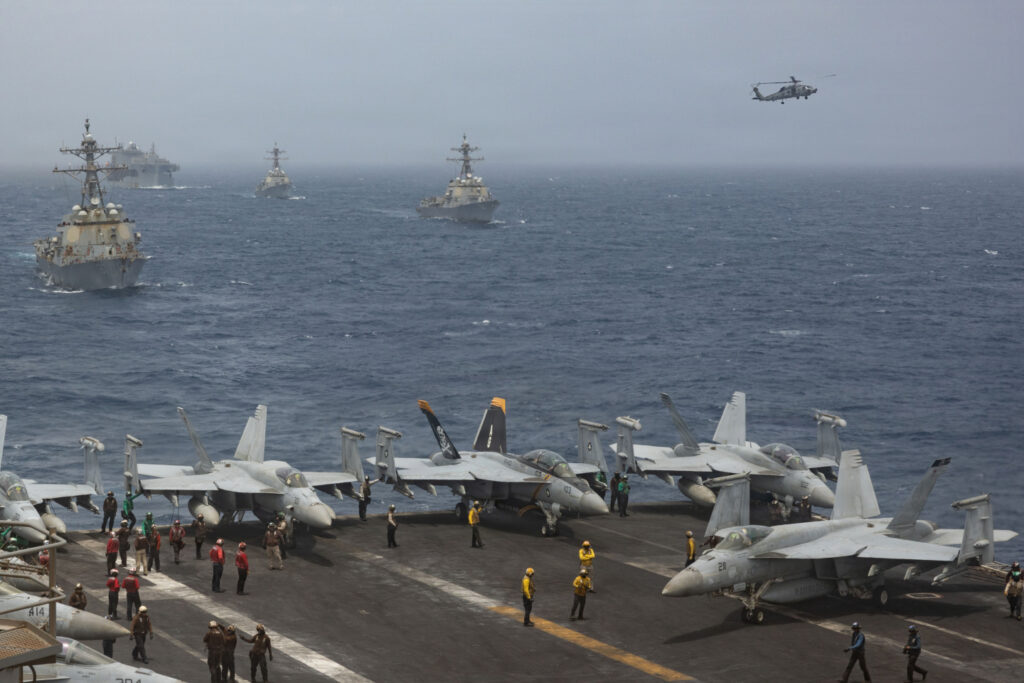
Since Merz is stuck in Berlin, he throws himself into foreign affairs and earned the media nickname Aussenkanzler (chancellor of foreign affairs). But on the larger international stage he fared no better. The war in Iran brought him into conflict with President Trump, with whom Merz had still been in good standing. He called the conflict with Iran “not our war” and added that Iran is “humiliating” America. Trump is threatening to withdraw American troops from Germany.
Germany has no leverage vis-à-vis the United States. Merz keeps losing. So does his French partner, President Macron, who cuts a fine figure in Europe but is a clownish character at home. The American Secretary of State, Marco Rubio, pointed out that France, in military operations in Africa, pretends to colonial grandeur but is dependent on American transport aircraft.
There is one arena where Germany does exert direct influence: the EU. There Germany usually protects German showpieces. Traditionally that is the auto industry. The former chancellor Gerhard Schröder, nicknamed “Genosse der Bosse” (comrade of the bosses), stood squarely behind the Volkswagen group in the state of Lower Saxony, where Schröder began his political career.
Merz Finds New EU Taxes Unacceptable
In lobbying work, Germany was usually outdone by France. The French have their pawns in the European Commission; the Germans in the European Parliament. EU enlargement made that pattern more complex. Merz wants to do in Brussels what cannot be done in Berlin.
Ursula von der Leyen, president of the Commission, wants a total sum of 2,000 billion euros for the 2028-2034 budget period; the European Parliament, like the never-satisfied Very Hungry Caterpillar, even wants 2,200 billion. In the current budget period it is 1,200 billion. She demands new EU taxes. Merz cut straight through it: “unacceptable and impossible to sell.” Von der Leyen fell silent.
Hollowing Out AI Legislation at the European Level
Germany acts more assertively in Brussels the more its own country stagnates. Thus Germany, together with Austria, turns against EU legislative proposals on Artificial Intelligence (AI), calling them “too unambitious.” According to Berlin, “more courage” is needed and it must be “simpler.” It is striking that Germany is practically operating as a “cavalier seul” (going it alone).
Germany wants AI requirements not to be included in the EU’s AI legislation, but to be laid down in the sectoral legislation of the member states. This is a wish of large German companies such as Siemens and Bosch. At least ten member states, including the Netherlands, are opposed. Germany is in fact hollowing out AI legislation at the European level.
Another theme is the “Industrial Fund” of 400 billion euros, where Poland wants a broader regional distribution of projects, while Germany believes that most of the money should go to the most competitive and innovative projects, regardless of geographic location. Poland and Germany have opposing interests. Germany also wants a European Palantir, following the example of the American data-analysis giant.
In order to be less dependent on the United States, Germany is seeking closer contacts with the “Global South,” countries such as Brazil in Latin America, plus Singapore and Australia in Southeast Asia. These are “medium-sized countries,” serving as a counterweight. Germany is also lobbying, as a peacemaker, to become a member of the UN Security Council.
Bonnie and Clyde
The SPD likewise makes its presence felt abroad. Klingbeil was prominently present at the “Global Progressive Mobilization” in Barcelona on April 17 and 18 to warn the world against “the rise of the far right.” That last term is a euphemism, referring to Trump and the AfD. Present were Brazilian President Lula da Silva, South Africa’s President Cyril Ramaphosa, and Mexican President Claudia Sheinbaum.
The organizer was Spanish Prime Minister Pedro Sánchez, who set himself up as a champion of the left, something he began during the Gaza conflict. He turned against Israel, closed the Spanish embassy there, and subsequently opened a Spanish embassy in Iran. Sánchez casts himself as the “left-wing conscience” of Europe, while his wife Begoña is being prosecuted in Spain for fraud and corruption. The public prosecutor is demanding a prison sentence of 24 years. The Werdegang (career trajectory) of Sánchez and spouse seems like a Spanish version of “Bonnie and Clyde.”
Fatalism and Stubbornness
Merz and Klingbeil cannot solve their problems in Germany with activism “im Ausland” (abroad). The core of those problems lies in wrong policy: a planned economy and the inability to change course together. German energy and climate policy ushered in economic decline, combined with excessive immigration from countries with completely different cultures. On energy policy, Merz has talked himself into a corner. During a visit by Czech Prime Minister Andrej Babiš to Berlin, Merz said: “Previous German governments decided to phase out nuclear energy. That decision is irreversible.”
A fatalistic line of reasoning. The German nuclear power plants have not (yet) been dismantled, but shut down or closed. Some, such as the KKE Emsland in Lingen, just across the Dutch border, could perhaps be brought back into use. But the political courage is lacking. Merz effectively believes: German governments wrongly closed nuclear power plants. That was a mistake, but nothing can be done about it. We carry on undeterred down the wrong road. In short: German “dickköpfigkeit” (pigheadedness).
The quarreling couple Merz-Klingbeil acts tough abroad but is “tote Hose” (dead in the water) at home. Whoever lays the political map of Germany next to the geographic one sees that East Germany largely votes AfD and West Germany is politically fragmented, with a rising AfD in the mix. There is still a wall; not physical but mental.
“The Schmerz of Merz”
Columnist Harald Martenstein recently wrote in Welt am Sonntag: “The GDR had a system of party bigwigs who were cut off from those ‘outside’ and were chiefly preoccupied with holding on to power and with intrigues ‘inside.’ In the GDR, work was simulated, nothing new was created, and problems were camouflaged, until it no longer worked.”
This autumn there are three East German state elections: the city-state of Berlin, Saxony-Anhalt, and Mecklenburg-Vorpommern. With the AfD as frontrunner in the latter two.
The “Schmerz (pain) of Merz” continues. The question is: for how much longer?
Derk Jan Eppink is a Distinguished Fellow at the Gold Institute for International Strategy, a Washington D.C.-based foreign policy and defense think tank.